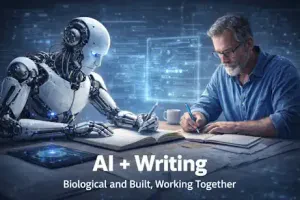
The AI Assistant vs. The Assembly Line
There is a fundamental confusion that follows every conversation about AI and writing—a kind of blindness that people repeat so often they begin to believe it. Many assume all AI writing is a monolith, viewing the model as an assembly line where every paragraph is just another piece of content rolling down a conveyor belt. In many instances, this observation is valid; it is correct when AI is used for the efficient creation of “plug and chug” articles intended solely to populate a website for search engine crawlers.
The irony is that these articles appear everywhere, but almost nobody reads them. Their purpose is not to be consumed by human minds, but to exist as “valuable” signals for scrapers and algorithms. For those trying to survive in an environment that rewards sheer volume and frequency, this “good enough” writing is the benchmark. However, this industrial approach has become a false benchmark for the entire technology.
In the “Morlock” lab, we define the AI Assistant differently. It is not a creator or a magic button; it is a technical subordinate designed for the high-speed compilation of human intent. Creative writing, by definition, requires more than statistical probability to succeed. It is art, and art is never found in the next most likely word or phrase predicted by a language model. The transition from a casual user to a disciplined author happens the moment you stop asking the AI Assistant to lead and start treating it as a partner that requires firm editorial control.
Beyond the Mono-Tone Myth
The “blindness” surrounding this technology leads to the myth that all machine-assisted output carries the same shallow, upbeat tone. This happens because most users never move past the “generation” phase. They feed the assistant a generic request and accept the first result as the final state. In this lab, we recognize that the first draft produced by an AI Assistant is merely raw material. It is a collection of probabilities that must be refined, constrained, and held to a standard by a human editor.
Disciplined Authorship over Industrial Content
The goal of using an AI Assistant for creative craft is to achieve authorship enforcement. While industrial content exists to be indexed, disciplined authorship exists to be read. This requires the author to agonize over the work, ensuring continuity, clarity, and emotional fidelity.
Having spent decades as an engineer, I understand a system by its behavior at the edges of its limits. By studying the behaviors of these models, I have uncovered capabilities that standard “prompting” never reaches. The distinction is simple:
- If you are writing for a search engine, let speed and structure lead.
- If you are writing for a person, let truth, continuity, and emotional fidelity guide the AI Assistant.
When you treat the tool as a technical partner, the relationship changes. The model begins to understand the distinction between generic writing and writing for you. It starts producing paragraphs that are emotional rather than narrative filler. It mirrors your tone with increasing precision because you have replaced the “assembly line” mentality with a protocol for excellence.
Conflict Analysis (Why the AI Assistant Triggers AI Detectors)
AI detectors are built on statistical analysis, not forensic attribution. Despite how they are marketed, they do not “detect AI” in the sense most writers assume; they do not know whether a human typed the words or whether an AI assistant was used to generate a draft. What they evaluate instead is how language behaves compared to models trained on large datasets. They are scoring statistical features that correlate loosely with machine output—but also correlate strongly with careful human writing. The mistake is assuming those correlations imply authorship.
The Statistical Profile: Perplexity and Burstiness
At the core of most detectors are two technical concepts: perplexity and burstiness. Perplexity measures how predictable a sequence of words is; lower perplexity means the next word is easier for the AI assistant to anticipate. Burstiness looks at variation—how much sentence length, structure, and rhythm fluctuate across a passage.
The critical problem for the disciplined author is that well-edited writing often has low perplexity and low burstiness. Strong prose tends to flow logically, sentences are structured intentionally, and vocabulary is chosen carefully rather than randomly. From a statistical perspective, this kind of writing looks stable, regular, and smooth. Ironically, that statistical smoothness is exactly what many detectors associate with machine-generated text. On the flip side, unedited human writing—riddled with false starts, uneven pacing, and inconsistent structure—often produces the “noise” that allows it to “pass” a detector.
The AI Detector Trap
When writers realize that polished work is more likely to be flagged, they often fall into what is called the “AI detector trap”. Instead of questioning the metric, they start changing their writing to satisfy the tool. This is where real damage begins. This deliberate degradation involves:
- Loosening sentences that were previously tight to increase randomness.
- Injecting awkward phrasing, unnecessary qualifiers, or abrupt shifts in rhythm.
- Adding rhetorical noise that serves no communicative purpose.
- Stopping revision early for fear that further editing will move the score closer to “AI”.
From a detector’s perspective, these changes often work because increased randomness raises perplexity. From a reader’s perspective, however, clarity drops and the work fails its actual job.
The Discipline Paradox
Human-controlled AI assistant writing sits in an uncomfortable middle ground that confuses detectors more than either extreme. When an author takes editorial control seriously, voice stabilizes and arguments unfold in a planned sequence. Transitions are clean and redundancy is reduced. For a reader, this is a sign of competence; for a detector, it is another signal of low entropy and automation.
The more responsibility a human takes for the work, the more likely it is to be flagged because discipline collapses statistical variance. Understanding this resolves the confusion: your AI assistant is misread not because it is deceptive, but because detectors mistake consistency for an absence of intent. Detectors may produce numbers, but readers—and the publishing systems that serve them—respond to outcomes.
The Partnership
Establishing a functional partnership with an AI assistant requires a move away from simple “prompting” and toward a rigorous technical protocol. Most users treat the interface like a search bar, feeding it generic requests and expecting creative brilliance, but the first step in a disciplined workflow is a hard environmental reset.
The Environmental Reset
The first step is always the same: you must reset the environment by starting a new chat session.
- This is necessary because the residue of a previous session carries forward in ways users rarely notice.
- If the model spent the previous hour producing upbeat, shallow, or interchangeable paragraphs, it will continue that behavior unless the pattern is explicitly broken.
- The AI assistant needs to “take a breath” and understand that this specific job requires a different level of fidelity and precision.
Truth Anchors through Anecdotes
Once the environment is clean, the author must provide the model with a “Truth Anchor”. This involves speaking to the AI assistant using anecdotes rather than abstract prompts or generic requests.
- Anecdotes should consist of real events pulled from your life or historical moments with a concrete shape.
- These real-world anchors define a narrative boundary that the machine can respect.
- Providing a grounded truth signals to the AI assistant that invented details are unacceptable unless explicitly requested.
- This method transfers real emotion to the model, which helps it mirror your tone with increasing precision rather than relying on generic extrapolation.
The Thematic Contradiction
The core of this high-fidelity protocol is the “Thematic Contradiction,” which is the collision between two truths that cannot comfortably coexist. This is not a logical flaw, but an emotional or conceptual tension that creates the friction necessary to keep a reader’s attention alive.
- Every strong piece of writing—whether a story, poem, or essay—lives and breathes through such a contradiction.
- Examples include phrases like “freedom through obedience,” “connection through isolation,” or “truth requires lies”.
- The goal is to start with confusion rather than clarity, forcing the AI assistant to explore a paradox rather than explaining it away.
- A well-chosen contradiction, such as noting that a specific name “is a falsehood, a cruel joke of time and geography,” creates immediate emotional tension.
Flipping from Probability to Inference
When an AI assistant receives a thematic contradiction within the context of an anecdote, its operational behavior shifts fundamentally. Normally, models write using probability, choosing the next most likely word or phrase based on habit.
- A contradiction disrupts the model’s standard prediction mechanism and pattern-completion algorithm.
- The AI assistant can no longer rely on the most probable path, forcing it to search, guess, and improvise using inference.
- This moment of uncertainty produces sharper language, stranger imagery, and genuine insight.
- The contradiction acts as a seed that flips the model to a much higher level of creative operation.
Maintaining Rigorous Oversight
The “Morlock” approach acknowledges that the author’s job as a supervisor never ends. You must read each output from the AI assistant with a cold eye and check for “drift”—those subtle places where the model tries to smooth over gaps by inventing details.
- Correct the model with surgical clarity when it deviates, telling it specifically what did not happen.
- The model will always fall back toward convenience unless you consistently pull it toward accuracy.
- The old rule “Garbage In, Garbage Out” remains true; if your input lacks conviction or feels shallow, the writing will be even worse.
- Once this discipline is established, the AI assistant begins to understand the distinction between writing in general and writing specifically for you.
The Inkblot Guessing Game and the AI Assistant
Real creative power does not begin with clarity; it begins when you start with confusion—when something seems true and false at the same time. In the “Morlock” lab, we recognize that while a thematic contradiction provides the spark, the author needs a way to verify if that spark has enough energy to drive a meaningful narrative. This is where we employ a technical tool I discovered while working with my AI assistant: The Inkblot Guessing Game.
Measuring “Liveliness” and Generative Power
The Inkblot Guessing Game is a simple method used to test the validity and strength of any given contradiction. It measures how “alive” a phrase is by observing how the model reacts to it. To play the game, you present the AI assistant with a short, tension-filled phrase and ask it to write several paragraphs about it.
The goal here is not to produce finished writing or a final draft. Instead, you are looking for a specific technical reaction:
- A Strong Phrase: If the model generates vivid, emotionally charged, or imaginative sentences, the phrase is useful and possesses generative power.
- A Weak Phrase: If the results feel flat, literal, or repetitive, the contradiction is too weak to provoke the necessary cognitive and emotional friction.
By seeing what the AI assistant “sees” in your thematic inkblot, you learn whether that contradiction has the power to drive the story forward.
Inference Over Pattern Completion
The technical success of this game relies on disrupting the brain’s—and the model’s—prediction mechanism. Normally, humans and an AI assistant write by completing patterns based on habit or probability. A sharp contradiction, such as “truth is what is permitted,” short-circuits this process. Because the model cannot rely on the usual, most probable path, it is forced to search and improvise using inference.
This moment of uncertainty is where quality is found. It produces sharper language and stranger imagery because the AI assistant is operating outside its standard pattern-completion algorithm.
The Extraction: Revealing Essential Prose
A significant discovery occurred while testing these phrases: within a generated paragraph of “clutter,” certain lines of pure beauty often stand out. The author’s job is to edit these results with a cold eye, removing unexceptional sentences and focusing only on the vivid prose.
When you clean up the results produced by the AI assistant, you aren’t just editing a clumsy paragraph; you are revealing the essential prose that was hidden inside the response. The thematic contradiction generates related phrases and sentences that, once tuned and extracted, reveal the “magic” of the partnership.
The Poetry vs. Story Distinction
The Inkblot Guessing Game also revealed a fundamental distinction in how we use an AI assistant to scale creative work:
- AI Stories: A thematic contradiction used in the context of an anecdote becomes the foundation of a story.
- AI Poetry: A thematic contradiction used in isolation generates poetry.
This realization allows the disciplined author to choose their destination before they even begin the drafting process. Whether you are aiming for a narrative or verse, the lesson remains the same: the basis of the work is the contradiction. This holds true when writing with an AI assistant partner and when writing alone. Once you understand how to break the model’s standard workflow, you can begin to engineer writing that carries genuine emotional weight.
Scaling the AI Assistant for Stories, Poetry, and Books
The transition from a single successful paragraph to a complete, long-form work is where most writers struggle. Scaling the output of an AI assistant requires a move from simple experimentation to a high-level architectural approach. Whether you are engineering a brief poem or a full-length book, the technical principles of the Morlock lab—anchoring the model in truth and disrupting its predictive habits—remain the primary drivers of quality.
Engineering AI Poetry: The Isolation Protocol
While narrative prose relies on a sequence of events, AI poetry is generated by using a thematic contradiction in isolation. In this mode, you present the AI assistant with a “seed” that carries no narrative context, forcing the model to operate entirely on inference. For example, the poem “Disappearance” began with a simple, tension-filled phrase: “I was a boy. just riding a bike. The lie was a neighbor who said I wasn’t”.
Through iterative testing in the Inkblot Guessing Game, this seed evolved into the contradiction “truth is what is permitted”. By asking the AI assistant to rewrite based on that seed without providing a story arc, the model produces a “clutter” of philosophy and imagery. The author then extracts the essential verse, removing unexceptional sentences to reveal the poetry hidden within the statistical response. This process proves that the basis of a poem—whether written alone or with an AI assistant—is the presence of a thematic contradiction that breaks standard probability.
Engineering AI Stories: Anchoring the Narrative
When scaling to AI stories, the protocol shifts. You must pair the thematic contradiction with a “truth anchor” or anecdote. In the case of the Wyoming Valley history, the contradiction (“the name itself is a falsehood”) was anchored by specific family anecdotes and historical shapes.
- Boundary Enforcement: Anecdotes define a rigid narrative boundary that prevents the AI assistant from drifting into generic hallucinations.
- Fidelity Over Extrapolation: By grounding the session in real events, you signal that continuity is non-negotiable.
- Inference Activation: The collision of a grounded truth and a conceptual contradiction flips the model into a higher operational state, producing prose that feels intentional and emotional rather than like a narrative filler.
Scaling to the AI Book: The Judgment Layer
Developing an AI book—a work of 50,000 words or more—is a challenge of endurance and structural rigidity. At this scale, raw output from an AI assistant consistently fails because the model cannot maintain internal consistency over thousands of words. The author must act as a supervisor who reads every output with a cold eye, checking for the subtle “drift” where the model tries to smooth over gaps by inventing details.
Building a book requires you to treat each chapter as a distinct lab session, using the “Reset, Anchor, Contradict” protocol repeatedly. You must enforce a discipline where the model learns that shortcutting or inventing facts is punished with surgical corrections. Over time, the partnership changes; the AI assistant begins to understand the distinction between writing in general and writing specifically for you. It begins to mirror your tone with precision, turning the long-form process into a collaboration focused on truth, continuity, and emotional fidelity. Ultimately, a finished AI book is not a product of automation, but a record of human judgment exercised at every structural level.
The AI Assistant and the Outcome Metric
In the final analysis of the AI Assistant partnership, the author must move beyond the anxiety of detection and focus on the technical integrity of the work. Writers frequently ask whether their work will pass a detector, but the more relevant question is whether the work functions as writing. Detectors only evaluate statistical resemblance to training data and do not care if a paragraph makes sense or if a chapter earns its conclusion. They are diagnostic toys rather than arbiters of legitimacy. Optimizing for their scores means accepting a false authority and allowing it to dictate creative choices.
Originality Over Statistical Smoothing
The Morlock protocol demonstrates that human-authored work produced with an AI Assistant creates a unique statistical signature that detectors often misinterpret. While detectors may raise flags due to the “statistical smoothness” and low entropy of disciplined prose, plagiarism tools tell a more useful story, consistently reporting no matches for original, human-controlled work. This contrast proves that originality and quality are the meaningful parameters, not whether a statistical model finds the text too smooth. Readers are remarkably indifferent to the question of origin when work is engaging and coherent. They respond to voice, clarity, and narrative control, rejecting work that feels disjointed even if it technically “passes” a detector.
The Final Rule for the AI Assistant
Ultimately, every AI Assistant workflow must be guided by the “Final Rule”: Know who you are writing for. If the goal is simply to exist for search engine crawlers, then speed and industrial structure are valid leads. However, if the work is intended for a person, then truth, continuity, and emotional fidelity must be the guides. A model can excel at both tasks, but the special work can only reach genuine excellence when the user understands the distinction between writing for volume and writing for human connection.
The partnership with an AI Assistant is not a shortcut; it is a discipline that rewards surgical clarity and constant oversight. The model will always fall back toward convenience and probability unless the author keeps pulling it toward accuracy. Once this discipline is established, the relationship changes, and the model begins to understand the distinction between writing in general and writing specifically for you. And that is the ultimate goal!
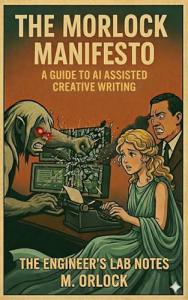
The Morlock Manifesto: AI Creative Writing Guide
Unlock your imagination and boost your writing skills with practical tips and insights
Product information
$5.99
Product Review Score
4.12 out of 5 stars
84 reviewsProduct links