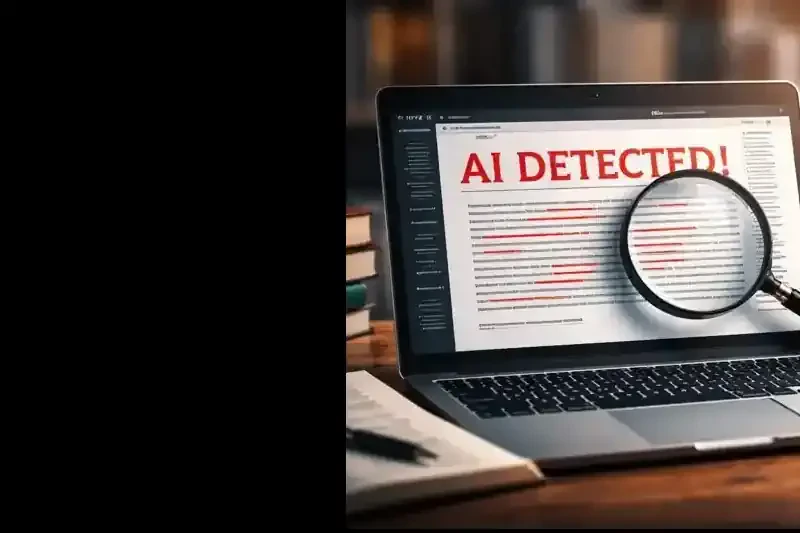
AI Detectors: The Confusion
Writers encountering an AI detector for the first time usually assume a simple premise: the AI detector is trying to determine whether a human or a machine wrote the text. When a piece of writing that feels deliberate, coherent, and well-edited is flagged as “likely AI,” the reaction is confusion followed by frustration. The instinctive conclusion is that something is wrong with the tool, or worse, that good writing itself has become suspicious.
That assumption is understandable—and wrong. The AI Detector is not examining authorship in any meaningful sense. They are not tracing provenance, intent, or creative decision-making. They are not asking who wrote the text, why it was written, or how it was revised. What they measure instead is statistical behavior: how predictable the language is, how evenly it flows, how consistent the structure remains across sentences and paragraphs. These signals have very little to do with authorship and a great deal to do with discipline.
This is where the confusion starts. Writers equate smoothness with quality, and quality with humanity. The AI Detector often equate smoothness with predictability, and predictability with automation. When those two perspectives collide, well-constructed AI writing becomes suspect precisely because it behaves the way good writing often does: it avoids unnecessary noise, maintains continuity, and does not lurch randomly from idea to idea.
The problem is compounded by how these tools are discussed online. Forums, social media posts, and tool marketing copy all reinforce the idea that an AI detector can reliably distinguish “human” from “AI.” That framing creates a false binary and pushes writers into a defensive posture. Instead of asking whether their work communicates clearly or holds together structurally, they begin asking how to make it appear less consistent, less polished, less intentional.
That shift is damaging. It reframes writing as a performance for an algorithm rather than an act of communication with a reader. Worse, it encourages writers to undermine their own work in order to satisfy a metric that was never designed to measure authorship in the first place.
This article starts from a simpler position: before worrying about how to pass an AI detector, it’s necessary to understand what the detector is actually doing. Once that is clear, the behavior of these tools stops looking mysterious. Good writing getting flagged is not a paradox. It is a predictable outcome of how detectors are built and what they measure.
What The AI Detector Actually Measures
The AI detector is built on statistical analysis, not forensic attribution. Despite how they are marketed, they do not “detect AI” in the sense most writers assume. They do not know whether a human typed the words, whether an AI generated a draft, or whether the text passed through multiple rounds of revision. What they evaluate is how language behaves compared to models trained on large corpora of text.
At the core of most detectors are concepts like perplexity and burstiness. Perplexity measures how predictable a sequence of words is given a language model. Lower perplexity means the next word in a sentence is easier to anticipate. Higher perplexity means the text contains more surprises. Burstiness looks at variation—how much sentence length, structure, and rhythm fluctuate across a passage.
Here’s the critical point: well-edited writing often has low perplexity and low burstiness. Strong prose tends to flow logically. Sentences are structured intentionally. Ideas are introduced, developed, and resolved without unnecessary detours. Vocabulary is chosen carefully rather than randomly. From a statistical perspective, this kind of writing looks stable, regular, and smooth.
That statistical smoothness is exactly what many detectors associate with machine-generated text.
On the flip side, unedited human writing—especially first drafts—often contains false starts, uneven pacing, abrupt shifts in tone, and inconsistent structure. Those irregularities increase perplexity and burstiness. Ironically, that makes sloppy or rushed human writing more likely to “pass” a detector, while disciplined writing is flagged.
This is not a bug in the AI detector. It is a consequence of how the models are trained. Detectors are comparing your text against distributions derived from AI-generated samples and large datasets of human writing. When those datasets overlap—and they increasingly do—the tool defaults to probability, not certainty. The more your writing resembles the statistical profile of curated, coherent language, the more “machine-like” it appears.
Editing makes this worse, not better. Every revision pass removes randomness. Every tightened paragraph reduces variance. Every continuity fix strengthens predictability. From a reader’s perspective, this is improvement. From a detector’s perspective, it is convergence.
This explains a pattern many writers observe but struggle to articulate: raw drafts sometimes score “human,” while polished versions score “AI.” The AI detector is not reacting to authorship. It is reacting to refinement.
Once this distinction is understood, the mystique around AI detectors fades. They are not judging creativity, originality, or intent. They are scoring statistical features that correlate loosely with machine output—but also correlate strongly with careful human writing. The mistake is assuming those correlations imply authorship.
The AI Detector Trap
Once writers realize that polished work is more likely to be flagged, many fall into what can be called the AI detector trap. Instead of questioning whether the detector is measuring anything meaningful, they start changing their writing to satisfy the tool. This is where real damage begins.
The most common response is deliberate degradation. Writers loosen sentences that were previously tight. They inject awkward phrasing, unnecessary qualifiers, or abrupt shifts in rhythm. Some intentionally vary sentence length in artificial ways or add rhetorical noise that serves no communicative purpose. Others stop revising early, afraid that additional editing will push the score further toward “AI.”
From a detector’s perspective, these changes often work. Increased randomness raises perplexity and burstiness, producing a score that looks more “human.” From a reader’s perspective, however, the writing suffers. Clarity drops. Arguments become harder to follow. Continuity weakens. The work may pass a detector while failing its actual job.
This creates a perverse incentive structure. Writers are rewarded for making their work worse in order to satisfy a statistical model that has no stake in reader comprehension. Over time, this trains people to associate quality with risk and sloppiness with safety. That inversion is corrosive, especially for long-form writing where coherence and continuity matter most.
The trap deepens when writers begin chasing specific scores. A piece that comes back as “60% human” is tweaked until it reads “80% human,” even if the changes make no conceptual sense. At that point, the detector has become the audience. The reader is secondary, if considered at all. Writing turns into a calibration exercise rather than an act of expression or communication.
This behavior also misunderstands how these tools are used in practice. Most platforms do not enforce detector scores as hard gates. Editors, moderators, and publishers know that detectors disagree with each other and produce false positives. What actually raises concern is inconsistency, plagiarism, or low-quality output—not statistical smoothness. Writing to appease a detector solves a problem that usually does not exist.
The AI detector trap is especially harmful because it feels rational. Writers believe they are adapting to a new environment, when in reality they are optimizing for a broken metric. The result is a generation of work that is noisier, less intentional, and less satisfying than it needs to be.
The real cost is not failing a detector. It is training yourself to abandon standards that matter to readers in order to satisfy a system that was never designed to judge writing as writing.
Why Human-Controlled AI Writing Gets Misread
Human-controlled AI writing sits in an uncomfortable middle ground that confuses detectors more than either extreme. It is not raw machine output, and it is not unstructured human drafting. It is something else entirely: a process where an AI assistant produces material that is then constrained, corrected, shaped, and held to a standard by a human editor. Statistically, this produces text that is unusually consistent—and that consistency is what gets misread.
When a human takes editorial control seriously, certain patterns emerge. Voice stabilizes across paragraphs. Terminology is used deliberately instead of drifting. Arguments unfold in a planned sequence rather than wandering. Transitions are clean. Redundancy is reduced. These are not traits of “machine writing” in the naive sense; they are traits of disciplined writing. But discipline is exactly what collapses statistical variance.
From the detector’s point of view, this looks suspicious. The text does not wobble. It does not contradict itself. It does not contain the minor inefficiencies that creep into most casual human writing. Sentence structure may vary, but the variation serves meaning rather than randomness. The result is prose that feels intentional from start to finish. Detectors interpret that intention as automation.
This misreading is amplified in long-form work. Over multiple pages, human-controlled AI writing often maintains continuity in ways that unaided human drafting struggles to sustain. Concepts introduced early are carried forward accurately. Tone remains stable. The narrative does not reset every few paragraphs. For a reader, this is a sign of competence. For a detector, it is another signal of low entropy.
There is also a temporal mismatch. The AI Detector will assume a single act of generation, while human-controlled AI writing is iterative. Drafts are generated, cut apart, recombined, rewritten, and refined over time. Decisions are made at a structural level that no detector can see. The final text reflects judgment, not generation, but the detector only sees the end state.
This is where the authorship conversation goes wrong. People assume that if AI was involved at any point, the output must carry detectable fingerprints. In reality, heavy human intervention removes many of the telltale artifacts associated with raw AI output. What remains is a clean, stable text—one that violates the detector’s assumptions about how humans are “supposed” to write.
The irony is hard to miss. The more responsibility a human takes for the work, the more likely it is to be flagged. The less care taken, the more “human” it appears statistically. This inversion leads to false conclusions about authorship and originality, when what is really being observed is the difference between unmanaged output and intentional writing.
Understanding this resolves much of the confusion. Human-controlled AI writing is not misread because it is deceptive. It is misread because detectors mistake discipline for automation and consistency for absence of intent.
The Publishing Reality
Outside of tool demos and online arguments, an AI detector occupies a much smaller role in actual publishing than people assume. In real workflows—whether self-publishing, editorial review, or platform moderation—AI detector scores are rarely treated as authoritative. They are, at most, a weak signal among many, and often they are ignored entirely.
One reason is inconsistency. Different AI detectors routinely disagree with each other on the same text. A passage might be labeled “likely AI” by one system and “likely human” by another, sometimes with high confidence in both directions. This alone makes them unreliable as enforcement mechanisms. When tools cannot agree on what they are measuring, they cannot be used as decisive evidence.
Another reason is that detectors do not align with how quality is evaluated in practice. Editors, readers, and platforms care about coherence, originality of ideas, internal consistency, and readability. None of those qualities map cleanly to perplexity scores or probability distributions. A book that holds together from the first page to the last is valuable regardless of how predictable its sentences appear to a statistical model.
In self-publishing ecosystems, this gap is even more pronounced. Platforms like Amazon do not apply AI detectors as gatekeeping tools for fiction or nonfiction. They enforce rules around plagiarism, copyright infringement, and content policy—not statistical smoothness. An AI detector flag, on its own, does not trigger takedowns or penalties. Actual enforcement requires human review or clear policy violations.
This reality is often obscured by online discourse. Writers share screenshots of detector results as if they represent judgment from an authority. In truth, those scores rarely travel beyond the person who ran the test. Readers never see them. Retail platforms do not surface them. Reviewers do not consult them. The only place they exert influence is in the writer’s own decision-making—and that is where the most harm occurs.
There is also a practical outcome worth noting: readers are remarkably indifferent to the question of origin when the work is coherent and engaging. They respond to voice, clarity, and narrative control. A piece that reads well is treated as authored, regardless of the tools involved. Conversely, work that feels disjointed or careless is rejected even if it technically “passes” every detector.
This creates a clear but often ignored distinction. Detectors operate in a theoretical space, scoring text against abstract statistical expectations. Publishing operates in a practical space, where finished work is judged by whether it functions as writing. Confusing one for the other leads writers to optimize for the wrong audience.
In real publishing environments, the only metric that consistently matters is whether the work holds together. The AI Detector may produce numbers, but readers—and the systems that serve them—respond to outcomes.
The Wrong Question
After enough exposure to AI detectors, it becomes clear that most of the anxiety surrounding them is misplaced. Writers keep asking whether their work will pass an AI detector, when the more relevant question is whether the work functions as writing. The two are not the same, and treating them as equivalent leads to bad decisions.
AI detectors encourage a framing error. They imply that authorship is something that can be inferred reliably from surface-level statistics. That implication pulls attention away from intention, judgment, and responsibility—elements that actually define authorship in practice. When writers internalize that framing, they begin optimizing for appearances instead of outcomes. The result is writing that exists to satisfy a tool rather than to communicate with a reader.
The right question is not “Will this be flagged?” The right question is “Does this hold together?” Does the argument remain coherent from start to finish? Does the voice stay consistent? Do ideas connect logically rather than collapsing into noise? These are the qualities readers notice, remember, and respond to. They are also the qualities that disciplined human control—whether AI-assisted or not—tends to produce.
Writing to appease detectors is a dead end because detectors do not read. They do not care whether a paragraph makes sense or whether a chapter earns its conclusion. They only evaluate statistical resemblance to training data. Optimizing for that resemblance means accepting a false authority and allowing it to dictate creative choices.
Human-authored AI writing exposes this weakness clearly. When AI is treated as a tool rather than a substitute—when drafts are revised, constrained, and shaped with intent—the final work often becomes too coherent for a detector’s assumptions. That is not a failure of authorship. It is evidence that authorship is being exercised.
The practical takeaway is simple. AI Detectors are diagnostic toys, not arbiters of legitimacy. They can be interesting to inspect, but they are not a standard to write toward. Writers who focus on continuity, clarity, and responsibility produce work that readers accept as authored, regardless of the tools involved.
Once that shift is made, the fear surrounding AI detectors loses its grip. The question stops being about whether the writing looks human enough and starts being about whether it is good enough. That is the only question that has ever mattered.
Addendum: What Our Experiments Actually Show
One reason AI detectors generate so much confusion is that most discussions about them remain abstract. People argue about theory, screenshots, or isolated samples. What The Morlock Manifesto documents instead is a series of practical experiments carried out in the course of producing finished work—stories, essays, and a complete book—under real publishing conditions.
As part of that process, the author subjected his own writing to multiple AI detectors and plagiarism checkers at different stages of revision. The results were not consistent in the way the tools’ marketing implies. The AI Detector scores fluctuated widely depending on revision depth, not authorship. Text that was carefully edited and structurally coherent was often flagged as “likely AI,” while earlier, rougher drafts sometimes passed as “human.” This reinforced the central observation discussed throughout this article: AI detectors respond to statistical regularity, not to creative origin.
Plagiarism checking told a different and more useful story. Across the same body of work—short fiction, nonfiction passages, and long-form chapters—plagiarism tools consistently reported no matches. The language was original. The ideas were not lifted. The structure was not derivative. Whatever tools were involved in drafting or revising, the finished output stood on its own as new work.
That contrast matters. AI Detectors raised flags where plagiarism tools found nothing. Readers responded to coherence and clarity where algorithms hesitated. The gap between those outcomes led to a clear conclusion: originality and quality are the meaningful parameters, not whether a statistical model finds the text too smooth.
The book treats these experiments as evidence, not anecdotes. Screenshots, examples, and revision notes are presented not to “prove” innocence, but to demonstrate how unreliable detector judgments become when human editorial discipline is applied. The work does not attempt to evade detectors. In many cases, it does the opposite—leaning into consistency, continuity, and structure—precisely to show how those traits are misclassified.
From that perspective, the lesson is straightforward. If writing is original, internally coherent, and intentionally constructed, it satisfies the criteria that actually matter in publishing: reader trust and creative responsibility. Detector scores, by contrast, are unstable and disconnected from those outcomes.
My book, The Morlock Manifesto is not a guide to beating tools. It is a record of what happens when AI is used as an assistant under firm human control and the results are tested against the systems people worry about most. It’s conclusion is not that AI detectors are malicious, but that they are asking the wrong questions. Quality and originality endure. Everything else is noise.