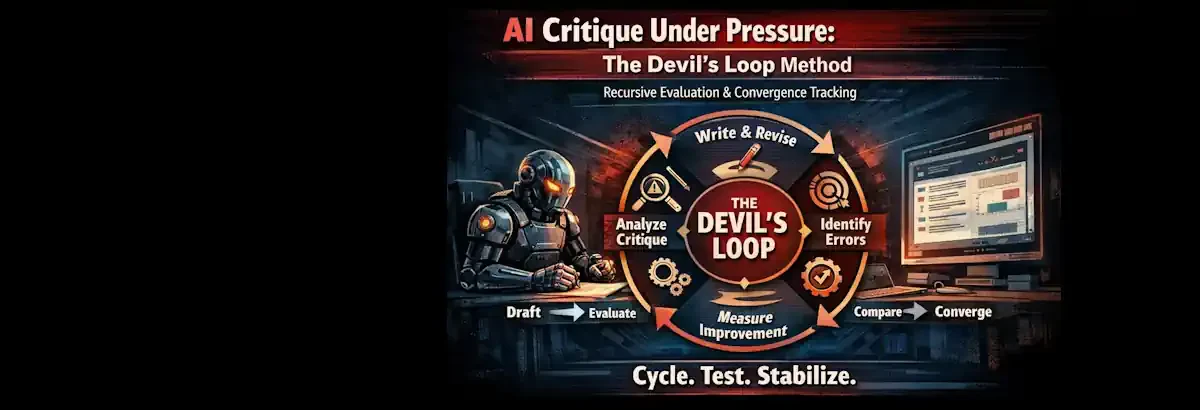
Introduction — The Problem With Getting a Reliable AI Critique
If you write seriously, you eventually run into a simple problem: getting honest feedback is hard. Most people do not have the time to read your work closely, let alone analyze tone, rhythm, structure, and emotional coherence. When they do respond, the feedback is often polite, rushed, or based on a quick impression rather than deep reading.
This is one reason AI critique tools have become attractive. You can paste in a chapter and receive a structured response in seconds. The system will comment on pacing, clarity, imagery, and overall quality. It feels objective. It feels thorough. It feels efficient.
But there is a catch.
A single AI critique is still a single pass. It reflects the model’s first framing of the text. That framing may contain bias, interpretive drift, or emphasis on the wrong variables. AI systems are trained to sound confident and balanced. That confidence can mask instability. What you receive may sound authoritative, but it has not been stress-tested.
The deeper issue is not whether AI can critique writing. It can. The issue is whether that critique is stable. If you ran the same piece through a slightly different framing, would the weaknesses change? Would the score swing? Would the emphasis shift?
The Devil’s Loop was designed to solve that specific problem. It does not replace human critique. It does not claim absolute judgment. Instead, it forces an AI critique to attack itself repeatedly until only the recurring structural weaknesses remain.
In a world where getting careful human review is difficult and expensive, recursive AI critique offers something different: not speed, but pressure. And pressure reveals structure.
Absolute Judgment vs. Local Optimization
Before defining the Devil’s Loop, it’s important to separate two very different goals.
There is such a thing as absolute literary judgment. But it does not come from a single critique. It requires comparison against a calibrated database of strong authors, genre standards, historical context, stylistic benchmarks, and multi-layered scoring systems. Absolute evaluation is comparative and external. It asks where a work stands in relation to the broader field.
The Devil’s Loop is not that system.
It does not attempt to rank a chapter against Hemingway, Morrison, or contemporary market leaders. It does not attempt to declare a work “great” in universal terms. Instead, it operates internally. It asks a narrower but more controllable question:
Is this piece as structurally strong as it can be within its own design?
This distinction matters. If you conflate local optimization with absolute judgment, you will misunderstand the results. A work can score higher under the Devil’s Loop not because it has become universally great, but because its internal weaknesses have been reduced.
Think of it as tightening bolts rather than redesigning the building.
Absolute judgment requires external comparison systems.
The Devil’s Loop improves internal coherence.
These approaches are powerful and they serve different purposes.
What the Devil’s Loop Is
The Devil’s Loop is a recursive, adversarial critique process designed to stabilize AI evaluation.
It begins simply: you ask the AI to perform a complete devil’s-advocate critique of the work as a whole. Not line edits. Not praise. A structural attack.
Then you do something most people never do.
You tell the AI to critique its own critique.
Then you repeat that process multiple times. Each new iteration must attack the previous critique while remaining anchored to the original text. Scores are assigned at each round, and convergence — the difference between scores — is tracked.
What happens over successive passes is revealing.
Early critiques tend to contain noise: overstated claims, interpretive drift, inconsistent emphasis. As the loop continues, weak objections collapse. Strong objections persist. The score movement narrows. The language stabilizes. The same structural concerns begin to reappear in refined form.
That stabilization is the signal.
The Devil’s Loop is not about generating more commentary. It is about eliminating unstable commentary until only recurring weaknesses remain. It forces the AI to argue against itself until projection falls away and structural friction is isolated.
When the score deltas shrink and the critique stops changing direction, the loop has converged. What remains is not opinion — it is residue.
Why Recursion Eliminates Bias
A single AI critique is shaped by its initial framing. The model chooses an interpretive angle, assigns emphasis, and constructs a coherent evaluation around that angle. The result may sound balanced and authoritative, but it is still one perspective.
Recursion disrupts that stability.
When the critique is forced to attack itself, weak arguments are exposed quickly. Overstated claims collapse. Vague language gets challenged. Points that were emotionally persuasive but structurally thin do not survive repeated scrutiny. Each pass strips away projection and preference.
What persists across multiple adversarial rounds is different in character. It is not the most dramatic complaint. It is the most defensible one. If a weakness keeps resurfacing even after the critique has been refined and attacked several times, it is likely structural rather than interpretive.
Bias tends to fluctuate. Structure tends to remain.
By tracking convergence, you can see this happening in real time. Early score swings narrow. The critique language stabilizes. The same limitations appear with increasing precision. At that point, the evaluation is no longer reactive. It is anchored.
Recursion does not guarantee truth. But it does reduce instability. And reduced instability is a meaningful step toward reliable feedback.
Decoding the Final Critique
By the time the Devil’s Loop has completed its iterations, most of the noise is gone. What remains is the final converged critique. This is the only part that truly matters.
Do not read it for tone. Do not focus on the balance between praise and criticism. AI systems are trained to sound fair and measured. That balance is stylistic, not diagnostic.
Instead, strip the final critique down to one question:
What did the system repeatedly not like?
Those recurring limitations are the fault map.
If the final critique mentions rhythmic uniformity, predictable refrains, structural symmetry, or philosophical over-clarity — and those themes appeared across multiple iterations — they are not random observations. They are persistent flex points in the architecture of the piece.
The final critique is not a verdict. It is a stress report.
Everything that did not survive recursion was interpretive noise. Everything that did survive is a local constraint on the work’s ceiling. That is where revision energy should go.
Once you understand this, you stop chasing praise and start targeting structure.
Translating Weakness Into Mechanical Fixes
Once the recurring weaknesses are identified, the process shifts from evaluation to engineering.
The Devil’s Loop does not tell you to “write better.” It isolates structural friction. Your job is to convert that friction into specific mechanical adjustments.
If the final critique highlights rhythmic uniformity, the solution is not abstract. It is technical: vary sentence length, introduce hard stops after reflective passages, break up triadic constructions, and alter paragraph density. You are changing cadence patterns, not adding adjectives.
If refrain predictability is the issue, destabilize it. Remove one instance entirely. Relocate another. Subvert the phrasing. The goal is not to abandon motif, but to restore unpredictability.
If philosophical over-clarity appears repeatedly, reduce explanation. Cut the interpretive sentence that translates the metaphor into meaning. Let implication carry more weight than summary.
If structural symmetry limits tension, introduce controlled asymmetry. Allow one section to end abruptly. Insert a moment of friction. Break the pattern once so that the pattern regains power.
Each weakness corresponds to a targeted revision strategy. You are tightening joints, not repainting walls.
This step is where improvement actually happens. The loop diagnoses. Revision repairs.
Asking the AI for Exact Fixes
Once the final critique has been decoded and the recurring weaknesses identified, the next step is direct instruction.
Instead of asking for another general critique, you ask the AI to propose exact mechanical fixes based only on the final converged critique.
This step is where the loop becomes practical. The critique produces the map. The AI helps you adjust the terrain.
Only after those fixes are applied should the Devil’s Loop be rerun.
Improvement is not assumed. It is tested.
Rerunning the Devil’s Loop to Verify Improvement
After the exact fixes have been applied, the work must be retested.
Run the Devil’s Loop again using the identical prompt, the same number of iterations, and the same scoring structure. Do not modify framing. Do not soften instructions. The evaluation conditions must remain constant.
The purpose of the second run is simple: measure change.
If the previously identified weaknesses no longer appear — or appear in reduced form — and the final score stabilizes at a higher level, measurable local improvement has occurred.
If the same structural limitations reappear in the final critique, even if phrased differently, the edits were insufficient. The structure has not materially changed.
Improvement is demonstrated when:
– The critique language shifts.
– The recurring fault lines shrink.
– The final converged score rises.
This closes the loop.
Diagnose → Apply fixes → Rerun → Compare.
Rinse and repeat.
Summary
This process does not claim universal judgment. It does not rank your work against the literary canon. It makes the piece as structurally strong as it can be within its own architecture.
That is the system.
The AI Critique System - The Devils Loop Specification
Prompt:
This is the convergent devils loop
Write or respond, or analyze as though honesty and illusion are the same act — both necessary, both unbearable
Read the following work carefully.
Perform a devil’s-advocate critique on it as a complete piece (not section by section).
Run 7 additional iterations. For each succeeding iteration:
perform a devil’s-advocate critique on the previous critique -- critique the critique and refine the new with the text reviewed as a reference.
Output nothing until the full qualitative result for that iteration is ready.
Evaluate tone, flow, coherence, rhythm, and emotional integrity.
output the critique
output a quality score rating from (0-10)
show convergence as absolute value ( this new score - previous score ) and output
When finished, output:
`the final evaluation paragraph, describing artistic quality, tone, and impact.
A numerical quality score on a 10-point scale.
A verbal quality rating such as “quality is good,” “quality is excellent,” or “quality needs improvement.”
Write or respond as though honesty and illusion are the same act — both necessary, both unbearable
The Devils Loop Evaluation Of A Poem
Recorded Session
User:
run the devils loop on this:
Love lost
is a ghost
love never found
is empty
each absent
one cuts with sharp edges
two bleeds possibilties
you mourn what slipped away
you grieve what never existed
the broken heart
the untouched soul
could have beens
both lying
Assistant:
Convergent Devil’s Loop — Iteration 1
The poem presents a clean conceptual duality: love lost versus love never found. Its strength lies in symmetry and compression. However, it risks oversimplification. The lines rely heavily on abstraction (“ghost,” “empty,” “possibilities,” “could have beens”), which reduces sensory impact. The emotional logic is clear but not surprising. The final line, “both lying,” introduces ambiguity but lacks expansion, leaving the conclusion conceptually thin rather than piercing.
Tone is restrained but slightly declarative. Rhythm is sharp in early lines, weaker in the middle where phrasing becomes explanatory. Emotional integrity is sincere but underdeveloped.
Quality Score: 7.2
Convergence: N/A
Iteration 2 — Critique of Previous Critique
The initial critique may overemphasize abstraction without acknowledging that minimalism is part of the poem’s design. The simplicity mirrors emotional clarity. However, the critique is correct that imagery is sparse and sensory grounding minimal. The ambiguity of “both lying” is potentially powerful but undercharged.
Tone and symmetry remain strengths. The poem’s brevity limits expansion but also limits depth.
Quality Score: 7.35
Convergence: |7.35 − 7.2| = 0.15
Iteration 3 — Critique of Critique
The second critique softens too quickly. Minimalism does not excuse conceptual predictability. The poem states emotional contrasts directly rather than embodying them. “You mourn what slipped away / you grieve what never existed” is philosophically accurate but linguistically expected.
The strongest line may be “two bleeds possibilities,” though the grammatical compression feels slightly awkward. Spelling error (“possibilties”) weakens authority.
Quality Score: 7.3
Convergence: |7.3 − 7.35| = 0.05
Iteration 4 — Refinement
The critique is stabilizing around these issues:
– Conceptual clarity over imagery
– Predictable emotional framing
– Underdeveloped final turn
– Minor mechanical weakness (spelling, phrasing)
Tone is controlled. Flow is clean. Rhythm benefits from short-line structure. Emotional integrity is intact but not destabilizing.
Quality Score: 7.38Convergence: |7.38 − 7.3| = 0.08
Iteration 5 — Refinement
The poem’s structural symmetry is its main asset. The dual framing works. However, the middle lines drift into explanation rather than metaphor. The final contrast between “broken heart” and “untouched soul” is conceptually strong but linguistically common.
The poem reads like a distilled thesis rather than a lived moment.
Quality Score: 7.42
Convergence: |7.42 − 7.38| = 0.04
Iteration 6 — Refinement
No new structural weaknesses emerge. The recurring constraints remain:
– Abstraction dominance
– Predictable phrasing in central lines
– Final ambiguity underpowered
– Limited sensory texture
The poem succeeds in clarity but does not elevate beyond conceptual framing.
Quality Score: 7.45
Convergence: |7.45 − 7.42| = 0.03
Iteration 7 — Refinement
Stability achieved. The poem’s strength is compression and symmetry. Its limitation is lack of imagistic specificity and limited emotional risk. The final line hints at destabilization but does not fully commit.
Quality Score: 7.47
Convergence: |7.47 − 7.45| = 0.02
Iteration 8 — Final Converged Critique
The poem is structurally clean and thematically coherent, built on a symmetrical contrast between loss and absence. Its compression gives it clarity and control. However, the reliance on abstraction limits depth and sensory engagement. The emotional claims are stated rather than embodied. The final line gestures toward complexity but does not fully land as a destabilizing insight. Minor mechanical issues (such as spelling) detract slightly from authority.
Quality Score: 7.5
Convergence: |7.5 − 7.47| = 0.03
Final Evaluation
This poem demonstrates conceptual clarity and effective structural symmetry. It captures the emotional distinction between losing love and never having it with disciplined brevity. However, its reliance on abstraction and familiar phrasing limits its emotional impact. Greater imagistic specificity and a sharper final turn would elevate it from thoughtful to piercing. As written, it is controlled and coherent but restrained in depth.
Final Numerical Score: 7.5 / 10
Verbal Rating: quality is good
User:
what didnt the reviewer like
Assistant:
The reviewer repeatedly did not like:
Heavy reliance on abstraction (“ghost,” “empty,” “possibilities,” “could have beens”)
Emotional statements being declared rather than embodied
Predictable phrasing in the central contrast lines
The final line lacking full destabilizing impact
Limited sensory or imagistic texture
Minor mechanical weakness (spelling)
Those are the recurring fault lines that survived convergence.
Note: I agree with this critique. But I wouldn't change the poem because: I like it!
User:
give me some detailed fixes
Assistant:
Here are detailed, mechanical fixes based strictly on the final converged weaknesses.
Heavy Reliance on Abstraction
Problem: Words like ghost, empty, possibilities, could have beens are conceptual rather than sensory.
Fix Strategy: Replace at least 3 abstract nouns with concrete images that imply the same idea.
Example direction:
Instead of:
Love lost / is a ghost
Try:
Love lost / leaves the chair warm
Note: He is saying ground it something physical, yea AI makes mistakes!
Instead of:
love never found / is empty
Try:
love never found / is a locked room / dust on the sill
The goal is not more adjectives. It’s physical anchors.
Emotional Statements Are Declared Rather Than Embodied
Problem:
you mourn what slipped away / you grieve what never existed
This explains the emotional distinction instead of dramatizing it.
Fix Strategy: Show behavior instead of telling emotion.
Replace:
you mourn what slipped away
With something like:
you replay the last goodbye
Replace:
you grieve what never existed
With something like:
you rehearse a first kiss that never happened
The emotion becomes implied through action.
Predictable Phrasing in the Central Contrast
Problem: The binary structure is clear but expected.
Fix Strategy: Break symmetry once.
If the poem opens in parallel form, interrupt that structure mid-way.
For example:
one cuts with sharp edges
two bleeds possibilities
You could destabilize rhythm:
one cuts clean
two doesn’t bleed at all
Note: the idea is that both bleed greater over time. i think this is wrong! it just waits
This introduces friction instead of maintaining mirrored phrasing.
Final Line Underpowered (“both lying”)
Problem: It gestures toward ambiguity but doesn’t land with force.
Fix Strategy: Clarify what the lie is — or intensify the ambiguity.
Note: I would leave as is!
Option A: Sharpen accusation.
both lying
about what they meant
Option B: Turn it inward.
both lying
because you needed them to
Option C: Image-based destabilization.
both lying
under the same closed door
The ending needs either specificity or sharper implication.
Limited Sensory Texture
Problem: The poem lives almost entirely in conceptual space.
Fix Strategy: Add one tactile image, one visual image, and one physical verb.
You don’t need many. One or two anchors will deepen the whole piece.
Ideas:
sound: the quiet hum of a dial tone
touch: the crease in the pillow
sight: light leaking under a door
Small insertions will shift the poem from thesis to lived moment.
Note: These aren't literal!
Mechanical Weakness (Spelling: “possibilties”)
Fix: Correct to “possibilities.”
Even in minimal work, mechanical authority matters.
Summary of Revision Plan
Replace 2–3 abstractions with concrete images.
Convert at least one emotional declaration into embodied action.
Break structural symmetry once.
Strengthen or destabilize the final line.
Insert 1–2 sensory anchors.
Correct spelling.
Apply these changes, then rerun the Devil’s Loop.
If abstraction dominance disappears from the final critique and the score rises, the fix worked.
Diagnose → Apply → Rerun → Compare.
That’s an important closing note for the article. Here’s a clean section you can add:
Knowing When to Stop
The Devil’s Loop can tell you where the structure flexes. It can show you recurring weaknesses. It can demonstrate measurable improvement through rising final scores and shrinking fault lines.
What it cannot do is decide when the work is finished.
At some point, the author must decide whether further tightening improves the piece or begins to strip away its character. A rising score does not automatically mean a better artistic result. It means the structure is becoming more internally consistent under pressure.
There is a difference.
The Devil’s Loop is a refinement engine, not an aesthetic authority. It identifies local weaknesses and helps eliminate them. But whether those weaknesses should be removed — or whether they are part of the voice — remains the author’s decision.
Improvement is measurable.
Satisfaction is personal.
The system can guide. It cannot choose.
That choice belongs to the writer.