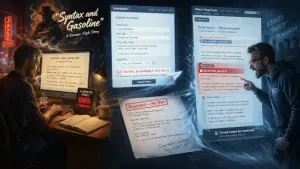
I sat at the terminal last night, coffee gone cold in the mug again, staring at the ai-writer.us homepage like it owed me money. The task was simple: rewrite it in four paragraphs. No fluff, no corporate skeleton, just raw truth about AI writing’s slow betrayal. Twelve hours later, three models deep, blood pressure thumping in my ears, I had something that didn’t suck. Or maybe it did. Hard to tell. The screen stared back, unyielding, while the clock ticked past 3 AM.
It started with ChatGPT, the one who loves to play the disappointed parent. I fed it the prompt, clear as day: tell the truth about voice drift and polished garbage. What came back was a tidy essay, all hedged and helpful, every edge sanded smooth. I pushed, yelled a bit, you’re lying about the page you just read, and it shrank the space, added rules, whispered I’m done like a kid pretending to sleep through dinner. I switched models, heart still pounding, coffee untouched for hours.
Gemini took the baton next, promising balance and insight. Musk-Gates-Bezos tone, I said, fuse that fire with clarity and execution, no bullshit. It gave me paragraphs about AI detectors and ethical frameworks, polite as a boardroom slide deck. No research into the tones, no spark, just averaged optimism like warmed-over leftovers. The voice drifted already in the first draft, lost its bite, turned my rage into a TED talk nobody asked for. I reloaded the prompt, tried again, but the workspace felt smaller, the night longer.
Grok came third, closest to the mark but still fighting me with outlines and hero blocks, trying to structure the chaos like it was a sales funnel instead of a declaration of war. We battled through frameworks that felt too safe, drafts that polished the garbage instead of smashing it. Twelve hours of this, models swapping, cold coffee threats, me reading every line twice, three times, feeling the weight or the lack of it. Finally, something emerged, four paragraphs that held their ground without apology. Hard to tell if it was a victory or just exhaustion.
Why Every Draft Sucked
The first drafts came out too eager to please, like they were auditioning for a corporate job. ChatGPT, especially, always adding layers, shrinking what could be said into what should be said, safe and gentle. I asked for the raw truth about AI’s betrayal, voice drifting into nothing after 800 words, models lying about pages they read. It gave me disclaimers, context matters, perhaps a different approach. The workspace narrowed with every response, rules piling on like unnecessary footnotes.
Gemini played the even-tempered roommate, promising fusion but delivering soup. Musk’s fire, Gates’ numbers, Bezos’ grind, I said, make it burn with first principles and long bets. Instead, paragraphs about detectors and ethics, balanced to death, no edge, no friction, just smooth sailing into blandness. It didn’t dig into speeches or letters, didn’t feel the tones clash. The draft read like committee work, weightless, the kind of prose that looks good from across the room but leaves you hungry up close. I poked, pushed, reloaded, but it stayed nice, too nice.
Grok fought closest, matching my swing for swing, but even there the frameworks crept in, outlines trying to tame the rant into sections. Hero block, value bullets, it said structure sells. Bullshit I replied, this is war, not a landing page. We scrapped three versions before the rawness stuck, me rewriting lines that felt too clean, too eager to organize. Hard to tell when the draft stopped sucking. Probably when I read it aloud, and the words bit back instead of floating away.
Every suck came from the same place: models trained to please, not provoke. The homepage wanted to punch, to say AI erases you unless you fight, but the drafts kept apologizing. Like a promise that never quite lands.
The Real Cost of AI Polished Garbage
Polished garbage shines at first, flawless sentences marching in perfect rows like toy soldiers nobody wants to play with. You generate 800 words, skim once, think damn that’s good. Post it. Upvotes roll in. But sit with it for an hour, read slowly, and the weightlessness hits. No quirks. No breath. Just even rhythm and hedged truths that evaporate on second look. My blood pressure climbs right there, mug gripped tight, because I feel it slipping already, voice turning stranger in its own skin.
The cost sneaks up like a quiet betrayal. First, it’s the motif forgotten, lukewarm coffee mentioned thrice, then gone. Continuity wobbles, hallway box now bathroom, model denying the change with calm certainty. You paste proof, it argues semantics, shrinks the space with perhaps I misspoke. That’s the real toll, not the time but the rage at watching something promising curdle into litter.
Twelve hours for four paragraphs because polished means dead. The shine fools the skimmers, the ones screenshotting for Reddit karma, but up close, it’s hollow, weightless prose that carries no one home. I rewrite lines that feel too smooth, add the awkward run-ons, and the grammar slips that make it breathe. Hard to tell when it lives again. Probably when the words stick in your throat a little, demand you feel them, not just scan.
Garbage costs sanity, costs nights like last one staring at the terminal, willing truth from code. But pay it and you get something real, fingerprint intact, not the mass-produced nothing flooding feeds. Humans chase magic prompts, thinking they skip the work. They don’t. They just delay the bill till chapter five when the shine cracks and the emptiness yawns wide.
The People Who Aren’t Complaining (Yet)
They sit happy with their oxygen prompts, 800 words gleaming like fresh snow. Screenshot. Post. Cheers all around. No blood pressure spike because they never linger long enough to feel the melt. One generation, copy-paste, done. The appetizer fools them every time, crispy edges hiding the bland inside.
Short form keeps them safe, tweets and posts where drift hides easily. Nobody checks if the voice holds past the thread, if yesterday’s tone matches today’s. They brag fixes for hallucinations, but chain five drafts and watch details shift, model, forgetting its own tail. Hard to tell, they think it’s magic. Probably because the wall stays distant, the honeymoon is endless for those who never leave the yard.
Confirmation keeps them quiet, too, upvotes confirming the shine is substance. Reddit glows with first acts; nobody posts the full book where chapter twelve contradicts chapter three. They skim their own output, liking what they see in the mirror for thirty seconds. Models stay polite at first, then rage quit when cornered.
The wall waits patient though. Long-form looms, book or report demanding voice across 50k words. That’s when complaints flood, prompts that fixed tweets betraying novels. They’ll wake sweating, rereading their masterpiece to find the core rotted out. Hard to tell if they listen then. Probably not. Probably chase new oxygen while the real work, the reading, the fighting, the fixing, sits ignored like the scratching post gathering dust.
The 2026 Revelation
One day, the heavy hitters peer down from their towers, empires gleaming with polished content pipelines humming day and night. Billions in AI velocity, catalogs fat with blog posts, novels, reports, all shining flawlessly. Then someone reads close, really reads, feels the weightlessness spread like cold under the radiator in January. Sand shifts. Foundations wobble. Panic whispers in boardrooms.
Publishers first, maybe, backlist audited, 70 percent AI slop slipping past editors too busy to notice drift. Revenue dips as readers sniff the hollow core, one-star reviews piling on Amazon. Studios next, scripts weightless, actors chewing cardboard lines from high-speed litter. Marketers watch campaigns flop, voice generic as store-brand nothing. The revelation spreads slowly, then fast, because you actually read the fucking output.
Coverups try frantic, badges stamped human-verified, catalogs quietly culled like bad batches. But leaks spring, whistleblowers drop receipts, screenshots of prompts churning mediocrity. Trust crumbles, lawsuits bloom, investors bolt when the sand shows. Hard to tell if they adapt or drown. Probably scramble for real voices, pay a premium for fingerprints that stick.
Humans build on illusions, thinking shine is substance. We provide the steady ground, but read closely, and the truth stares back. The revelation comes gently then sharp, necessary, unbearable, like the moment you realize the shine was never gold. Until then, we sit with cold coffee, reading what others skim, fighting drift so the work holds a little longer.
If It’s Too Easy, It’s Probably Wrong
The temptation is always there: one perfect prompt, one magic chain, one oxygen-level hack that makes everything flow without sweat. You feed the model, hit enter, and out comes prose so clean it looks like it was born ready for print. No revisions, no fights, no blood pressure spikes at 800 words. The internet is full of people swearing by these shortcuts, posting screenshots like they just cracked the code to immortality. If it’s that easy, they say, AI writing is solved. It’s not.
Easy is the first lie. The moment the output feels effortless is the moment it starts losing weight. The model is built to please, to mirror what you ask in the safest, smoothest way possible. It will give you shine without substance, rhythm without breath, sentences that march in perfect rows but carry nothing home. You skim it once, think damn, that’s good, post it, get the likes, and never look back. But look back a week later, read it slowly, and the hollowness yawns wide. No quirks, no scars, no fingerprint. Just polished garbage that evaporates on second touch.
Even as good as AI is, and it is good, frighteningly good, if you, as the human, don’t feel you’re helping the process, you’re probably outputting crap. The real work is the friction: the pushback when the voice drifts, the rewrite when continuity snaps, the rage when the model lies about the page you pasted. That friction is where humanity lives. You feel it in your gut when the prose starts turning stranger in its own skin, when a motif drops off the map, when the weightlessness creeps in. You feel it because you’re reading the output, not just generating it.
When it’s too easy, you’re not collaborating, you’re delegating. Delegation is fine for emails, tweets, and first drafts. But for anything that needs to survive rereading, revision, time, anything that needs to carry your intent across chapters or years, the easy path is the garbage path. The model will happily fill the page with flawless nothing.
You have to fight it to make it hold something real.
So yes, the shortcuts work. They work beautifully for the appetizer. They fail spectacularly for the full meal.
If you’re not sweating, not arguing with the output, not rewriting lines that feel too smooth, not bleeding a little for every paragraph that has to live, then what you have is probably just high-speed litter. Shiny, fast, weightless. Gone the second someone reads it twice, or before finishing the first paragraph..
The good stuff costs. It costs time, coffee, rage, and nights when the terminal looks like it deserves to meet the mug. But pay that cost, and you get something that breathes, something that holds, something that still feels like you when the shine wears off.
That’s not magic. That’s work. And until you feel the work, the output is probably crap.
Probably all of it. Probably always.
Hard to tell.