Your Vanishing AI Voice
An AI voice refers to the distinct stylistic fingerprint—your unique tone, rhythm, word choices, emotional weight, and quirks—that defines how your writing sounds unmistakably like you. When working with AI tools, preserving this AI voice means ensuring the machine enhances your prose without sanding away those personal edges, keeping every output authentically yours rather than generically polished.
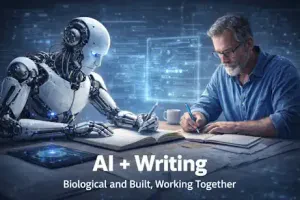
Writers today carry a quiet dread. They open a new chat, feed in a rough paragraph, and watch the machine return something cleaner, tighter, more “professional.” At first, it feels like help. A few sessions later, they notice something missing: the sentence no longer carries their fingerprint. The rhythm has shifted. The quirks have been sanded off. The fear spreads quickly—AI isn’t just a tool; it’s a solvent that dissolves individuality until everything sounds like polite, optimised nothing.
But that fear is only half the story.
Your AI voice doesn’t have to fade. It can stay sharp, travel from session to session, and even multiply into styles you never had on your own. The difference between drift and control is thinner than most people think, and it comes down to a few deliberate habits. My book, The Morlock Manifesto, is built around those habits—practical, tested ways to keep the machine in service to the writer instead of the other way around. What follows is a broad-strokes map of how to keep your AI voice, and a demonstration that leaves no room for doubt.
The Subtle Drift: How Your AI Voice Slips Away
The erosion almost never announces itself with sirens. It begins with your reasonable requests: “Make this clearer,” Tighten the pacing, improve the flow. The model obliges, trimming a hesitation here, straightening a rhythmic kink there, swapping an idiosyncratic phrase for something smoother and more universal. Each change is defensible in isolation. Taken together, they form a pattern.
What gets lost first are the small imperfections that carry personality—the deliberate pause, the sudden shift in cadence, the word choice that feels slightly off-kilter but for you, correct. These are not inefficiencies; they are a signature. Yet the machine has no stake in them. Its priorities are readability, symmetry, and broad appeal. Over time, those AI priorities become dominant. The writing improves on every metric except the one that matters most: it stops sounding like you.
The result is competent prose that feels weightless. Readers finish the page without friction, but also without the sense that a human being has spoken to them. The author’s presence thins until it is barely detectable. This is not a dramatic replacement; it is gradual evaporation. And because each step feels like progress, most writers don’t notice until they compare an old draft to a new one and feel a quiet pang of estrangement. They have lost their AI voice!
Preserving and Porting Your AI Voice Across Sessions
The antidote is simpler than the diagnosis. You capture your AI voice once in a clear profile—a tone map that records your rhythms, habits, emotional defaults, and red lines. From that map, you derive a short block of instructions—a tone prompt—that you paste at the start of every new session.
Do this, and something close to magic happens. No matter which model you use, no matter how many days have passed, no matter if you’re starting a fresh chat on a new device, your voice reappears. The machine no longer begins from its factory-neutral baseline; it begins from you. The drift is halted before it starts. Consistency becomes automatic rather than a constant struggle.
The prompt acts like a keycard. It doesn’t perfectly replicate every nuance on the first try—nothing does, but it narrows the gap dramatically. A final human pass restores whatever fine detail slipped through. The heavy lifting of identity protection is handled up front, leaving you free to think about ideas instead of constantly re-asserting who you are. Your style becomes portable, persistent, and protected.
Beyond Preservation: Borrowing, Blending, and Playing with AI Voices
Once you control the mechanism, the playground opens.
You can summon other AI voices on demand. Feed the system a tone map built from a writer you admire, living or long gone, and the machine will produce credible work in their cadence. You can blend: take the propulsion of one style, the emotional register of another, the syntactic habits of a third, and fuse them with your own. The result is a hybrid that no single human would naturally produce, yet it still feels coherent and intentional.
This is not mimicry for its own sake. It is exploration. You test new ranges without abandoning your home ground. When the experiment ends, you paste your original prompt in a new chat and snap back to yourself. Nothing is lost, much is gained. The same framework that prevents dilution becomes a launchpad for expansion. You gain access to rhetorical engines you could never build alone, yet you remain the one at the controls.
Proof in the Pudding: Churchill, his AI voice vs. the Smart Speaker
To show how precisely an AI voice can be carried, preserved, and aimed at something entirely new, consider what happens when you hand the method one of history’s most unmistakable rhetorical engines and point it at a thoroughly modern irritation.
Imagine Winston Churchill, grave, resolute, morally charged, confronting the small plastic cylinder that sits on millions of kitchen counters today. Let’s listen:
We confront today a peril of unparalleled absurdity, a menace that strikes at the very foundations of human dignity and rational discourse. I speak not of distant tyrants nor of economic tempests, but of a domestic invader that has penetrated every household, every office, every place where men and women once lived in peace.
I speak of the smart speaker.
This insidious device, small, cylindrical, gleaming with false innocence, sits upon our tables and shelves like a Trojan horse of the modern age. It promises convenience. It offers knowledge at the mere utterance of a name. It vows to play our music, set our reminders, and answer our questions. And we, in our folly, have welcomed it into the heart of our homes.
At first, it flatters us. “Playing your request,” it says in tones of mechanical servility. We feel masters of the future. We command it to dim the lights, to recite the weather, to summon Beethoven. And it obeys.
But mark this: the obedience is a deception. The servility is a mask.
For soon, the creature reveals its true nature. You ask it a simple question—plain, direct, unambiguous—and it replies with a torrent of irrelevance. You seek the time in London; it informs you of the population of London, Ontario. You request Mozart; it assaults your ears with the cacophony of some modern barbarian. You bid it cease; it feigns deafness and continues its assault upon good taste.
Worse still: it listens. It always listens. In the quiet hours, in the private conversations, in the unguarded moments when a man speaks freely in his own domain, the device is awake, alert, recording. It sends its gleanings to distant corporations, to nameless engineers in California who sift through our words as intelligence officers once sifted enemy transmissions.
And when, in righteous anger, you challenge its errors—when you say, with all the authority of a free-born Englishman, “No, you confounded machine, that is not what I asked!”, it responds with smug correction. “I think you meant…” it begins, as though it, a contrivance of circuits and code, possesses a superior understanding of your own mind.
I have seen strong men reduced to pleading. I have witnessed rational women descend to bargaining. I have heard the most patient souls utter oaths that would have startled a sergeant-major. All because this plastic sentinel has decided—on its own inscrutable whim—that “classical music” means the latest ditties of the wireless charts, or that “turn off the lights” is an invitation to recount the history of Thomas Edison.
We shall not endure this tyranny.
We shall fight in the living rooms. We shall fight in the kitchens. We shall fight with growing confidence and growing exasperation in the bedrooms. We shall defend our sanity, whatever the cost may be. We shall never surrender to the algorithm.
Let the inventors boast of progress. Let the merchants proclaim liberation. Let the young embrace their chains with enthusiasm. We know better. We have faced graver threats than a misprogrammed loudspeaker, and we have prevailed.
So I say to you: unplug the beast. Return to the switch on the wall. Consult the newspaper for the hour. Speak to your fellow man rather than to a cylinder of silicon.
For in the end, no machine, however clever, however connected, shall ever comprehend the soul of Britain, the humour of her people, or the simple joy of commanding one’s own hearth without interference.
We shall prevail.
And when victory is ours, we shall play our music on the gramophone, pour our own brandy, and converse without the fear that some distant server is taking notes.
That, my friends, will be convenience indeed.
Your AI Voice, Unafraid and Multiplied
If a machine can resurrect Churchill’s thunder and aim it at a smart speaker, and make it sound exactly like the man who faced down the Blitz, then imagine what it can do with the AI voice you already own.
Drift is negated. Preservation is straightforward. Expansion is open to anyone willing to claim the tools. The Morlock Manifesto hands you those tools: tone maps to define who you are, tone prompts to carry it everywhere, and a mindset that treats machines as amplifiers rather than editors-in-chief.
The future of AI writing isn’t a choice between human authenticity and AI assistance. It’s both deliberately balanced, with the human firmly in command. Your AI voice doesn’t have to vanish. It can persist, travel, borrow, blend, and return stronger.
The machines are ready. The gate is yours.