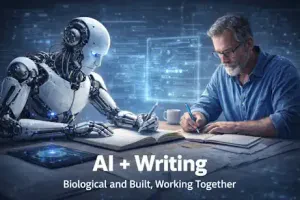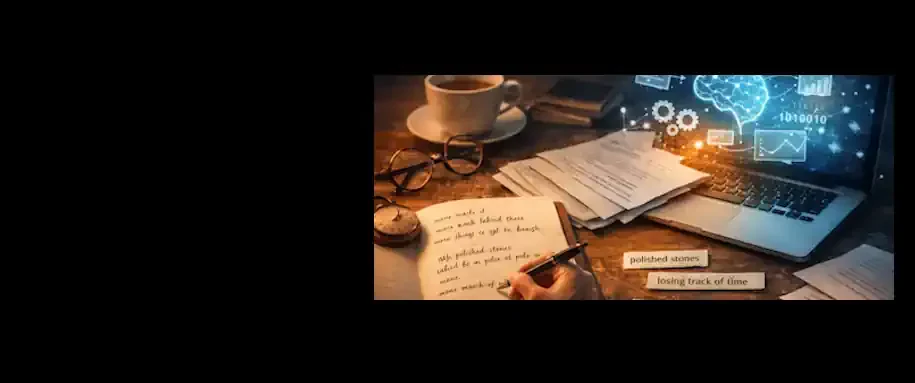
I love to write poetry with my AI partner. I have a fun little method that I use. Its consistent and the finished poem is on the human. The method is simple. Think of a thematic contradiction, ask ai to write several paragraphs about it. Use the contradiction as a seed and have AI rewrite the original paragraphs. Then you, the human pulls out the heat, the phrases that strike emotionally. Arrange them into a poem. Thats it! Follows are three we wrote this snowy Sunday morning. I have started withe the contradiction, then the AI written paragraphs, and finally the finished poem.
A crowded room where no one speaks truth
A crowded room where no one speaks truth—though truth stands there with them, breathing the same recycled air. The conversation is fluent, immaculate, carefully weighted. Words move like polished stones passed from palm to palm, warm but worn smooth of edge. No one is ignorant; ignorance would be simpler. They see the fracture running beneath the floorboards. They feel it in the small hesitations before a sentence resolves. Yet each voice chooses contour over incision. They describe outcomes, atmospheres, abstractions—never the wound itself. In this way, the lie is not a false statement but a shared choreography. They do not deny reality. They escort it politely around the room.
Because honesty without structure is demolition. And illusion without anchor is rot. So they perform the unbearable fusion: a truth wrapped in language that can be survived. The mask does not hide the face; it allows the face to remain intact. Every softened phrase carries the outline of what cannot be said outright. Every nod acknowledges the unsaid center. They are not protecting themselves from knowledge—they are rationing its force. In the crowded room, illusion becomes the vessel that lets truth circulate without shattering glass. And everyone understands that the cost of such mercy is weight: the weight of knowing, the weight of restraint, the weight of leaving the room unchanged.
Shared Choreography
no one speaks it
truth stands behind them
close enough to feel its breath

only polished stones
passed from palm to palm
warm
worn smooth of edge

They describe outcomes
never the wound itself

the lie is not a false statement
but a shared choreography

They do not deny reality
They escort it
politely
around the room.

And everyone understands
the cost of such mercy

is weight--
of knowing
of restraint
and leaving
behind or with
nothing
A clockmaker losing track of time
A clockmaker losing track of time is not a dramatic event. It is incremental. He calibrates seconds with tweezers and breath, aligns teeth no thicker than fingernails, listens for the disciplined click that means order is intact. The shop is full of obedient circles—faces that promise sequence, hands that insist on direction. He can correct their drift to the fraction. Yet when he looks up from the bench, afternoon has thinned without announcement. He cannot account for the hour that slipped between two adjustments. The truth is simple: he does not command time. The illusion is necessary: he must behave as if he does, or every clock in the room becomes a confession.
So he continues the ritual. Wind, set, regulate. Wind, set, regulate. Customers trust the symmetry of his motions, the authority of his loupe, the steady grammar of ticking behind glass. He gives them duration in polished brass and tempered steel. Alone, after closing, he stands among the synchronized testimony of a hundred small hearts and cannot locate his own. The unbearable fusion tightens: honesty and illusion meshing like gears. He cannot stop time, cannot hold it, cannot even feel it passing through him. But he can shape its appearance. And shaping the appearance is the only way he keeps from admitting that it has already moved on without him.
Left Behind
faces promise sequence
hands show the only direction
all constrained by obedient circles

hear the tick
alignment holds

he cannot stop it
he cannot hold it
he can only shape its appearance

and hope
it has not already
left him behind
Inference opposed to probability
The analyst stares at the model until the numbers begin to behave. Probability is polite. It rounds edges, distributes risk, assures him that outliers are noise. The graph hums with confidence intervals and shaded certainty. It does not claim truth; it claims likelihood. That is the comfort. He could live inside likelihood. He could let the bell curve carry him, let the average speak for him. But inference is not polite. It arrives as a fracture in the data, a pattern that should not be there but is. It does not smooth. It insists.
He knows the difference. Probability says the storm will probably miss the coast. Inference says the wind has shifted. Probability counts outcomes. Inference reads pressure. One protects reputation; the other risks it. To infer is to stand apart from the curve and claim the anomaly matters. The unbearable fusion is this: the data both conceals and reveals. The numbers are honest in aggregate and deceptive in particular. He must decide whether to shelter inside statistical mercy or step into the sharper weather of interpretation. Both are defensible. Only one feels like truth.
Next Likely Or Some Other Path
Next Likely Or Some Other Path

the analyst
makes the numbers behave

probability is polite
rounds edges
distributes risk
never certain

he rides the bell curve
averages carry him

the poet knows otherwise

he abandons the shelter of likely
and walks into weather
alone

both defensible
both deliberate
both craft
Enjoy!