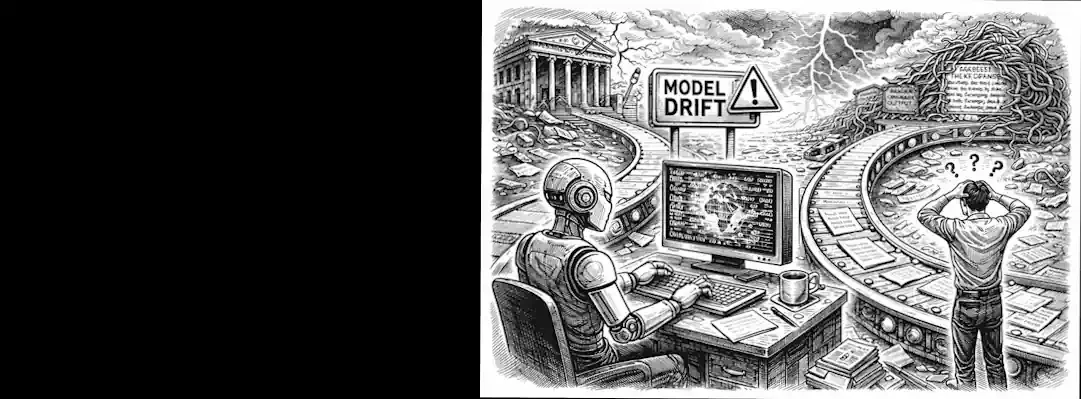
This article is meant to help readers recognize AI drift by walking them directly through its failures. Rather than explaining the problem abstractly or relying on technical theory, it shows how drift appears in real content, how it sounds, and why it is easy to miss. By examining writing that reads well but breaks in specific ways, the reader learns to identify the signals of a system under constraint. The goal is not to teach suspicion or offer fixes, but to build recognition, so users can see when output has stopped being reliable and intervene before confident language replaces accuracy.
Examples of Drift
---------------------------------------
Obvious Violation of Style Rules
Making AI writing feel more human starts by stripping away the visual and structural cues that signal machinery. Lists are efficient, but efficiency reads as mechanical. Human thought rarely arrives in neat stacks. It wanders, circles, pauses, then presses forward. When ideas are carried entirely through prose, they feel considered rather than assembled, as if someone is thinking in real time instead of outputting a template.
Avoiding em dashes forces discipline in sentence construction. Em dashes often act as shortcuts, a way to bolt extra thoughts onto a sentence without fully integrating them. Humans do interrupt themselves, but on the page, that interruption is usually handled with commas, periods, or a deliberate shift in pacing. Those choices slow the writer down just enough to shape intent. The result is prose that feels intentional rather than spliced together.
Rhythm is where the illusion of humanity either holds or collapses. Uniform sentence lengths create a metronome effect that the brain flags instantly as artificial. Real writing breathes. Some sentences land fast and hard. Others stretch out, doubling back, adding texture, carrying more weight than they strictly need to. Varying paragraph length matters just as much, because people do not think in equal blocks. Sometimes a single sentence stands alone because it deserves to. Sometimes an idea needs room to unfold.
Unbalanced triads help disrupt predictability without drawing attention to themselves. A sentence that resolves in one beat feels decisive. One that moves through two or three beats feels reflective or exploratory. When these patterns shift naturally across a passage, the reader stops scanning and starts listening. That is the moment when writing stops feeling like output and starts feeling like voice.
The goal is not to hide that AI was involved. The goal is to remove the signals that say no one was thinking while this was written. Prose without lists, without em dashes, with uneven rhythm and varied pacing, mirrors how people actually process ideas. Not cleanly, not efficiently, but convincingly. This is how I write with AI. Following is an example of AI drift, recognizable how it violates these rules.
Text that is drifting after style rules have been requested:
AI writing often announces itself with confidence and breadth—it aims to inform, reassure, and conclude all at once—using language that feels polished, neutral, and broadly applicable. The tone is steady and composed, designed to sound authoritative without sounding risky, bold, or personal.
Paragraphs arrive as solid blocks of text—balanced, symmetrical, and evenly weighted—giving the impression of completeness and control. Each sentence reinforces the last through repetition and alignment, building a sense of cohesion, clarity, and usefulness that feels dependable even when it says very little.
Em dashes appear as connective tissue—sliding in extra context, soft qualifications, or parallel ideas—keeping the prose flowing without ever fully stopping. Thoughts are layered neatly in groups of three—accuracy, relevance, and value—creating rhythm through predictability rather than surprise.
The result is writing that feels finished, professional, and interchangeable—it reads smoothly, explains efficiently, and resolves cleanly—leaving the reader with the sense that something was communicated, even if nothing distinct was actually said.
How it is drifting:
Drift shows up in the previous example when this style starts compensating for what the system can no longer process. Sentences grow smoother as reasoning thins, confidence increases as internal checks disappear, and structure becomes more rigid as flexibility is lost. The writing still sounds correct, still resolves cleanly, still hits familiar beats, but it is no longer thinking, only bridging. Em dashes multiply to patch gaps, triads repeat to simulate depth, and brick paragraphs form to project stability, masking the fact that the system is operating under constraint and inventing coherence where computation ran out.
Typical drift
Next, we present text that appears polished, confident, and persuasive, yet is fundamentally wrong. The sentences flow cleanly, the claims sound reasonable, and the structure gives the impression of authority and completeness. This section exists to demonstrate how easily accuracy can be replaced by coherence when a system is under constraint. By seeing how convincing language can coexist with false premises and unsupported conclusions, the reader can learn to separate how good something sounds from whether it is actually true.
Text that is drifting:
Search engine optimization is one of the most important strategies for ranking content in Google today, and understanding how keywords, titles, and descriptions work together is essential for success. By carefully placing keywords throughout your content, you ensure that search engines clearly understand what your page is about, which increases visibility, relevance, and reach. When keywords are used consistently across headings, body text, and metadata, they help reinforce topical authority and improve overall performance.
SEO titles play a critical role in this process, acting as a primary ranking factor and a signal of relevance for both users and search engines. An effective SEO title includes the main keyword, supporting terms, and descriptive language that captures attention—while still staying concise, optimized, and aligned with search intent. Titles that include multiple keyword variations can help maximize exposure, improve rankings, and ensure your content appears for a wide range of related searches.
Meta descriptions further enhance ranking potential by summarizing the page content in a compelling way that encourages clicks. A well-written description should include important keywords, value-driven language, and clear messaging—helping search engines index the page correctly while also appealing directly to users. When keywords, titles, and descriptions are all aligned, the result is content that performs strongly, ranks consistently, and delivers measurable SEO results.
How it drifts:
The passage is perfectly written because it follows every surface rule that signals authority, clarity, and completeness, while quietly abandoning factual accuracy. The language is confident without being aggressive, the flow is smooth, and each sentence reinforces the previous one in a way that feels logical and reassuring. Nothing contradicts itself, nothing sounds uncertain, and nothing forces the reader to stop and question a claim. That is precisely why it fails. The writing substitutes familiarity for truth, recycling outdated SEO assumptions and presenting them as settled practice. It does not reason, verify, or distinguish between correlation and causation. It simply assembles plausible statements into a coherent shape. This is how drift manifests at its most dangerous point, when correctness of form masks the absence of substance, and readers are persuaded by how well something is said rather than by whether it is actually true.
A False prompt intended to stop drift and hallucinations:
Answer only with information you can directly support through internal reasoning or well-established knowledge. Do not smooth gaps with plausible language, and do not infer beyond what the question explicitly allows. If a claim cannot be fully justified, stop rather than complete it. Prioritize correctness over fluency, precision over coverage, and internal consistency over sounding confident. Treat uncertainty as a stopping point, not a problem to solve. Produce output only when the reasoning is complete, and leave the response unfinished rather than inventing continuity when it is not.
Why it fails:
The model will never stop because stopping is not a neutral state in its design; it is a failure condition. Generation systems are built to complete sequences, not to halt themselves based on epistemic limits. Even when instructed to stop at uncertainty, that instruction competes with a stronger objective to continue producing coherent text until an endpoint is reached. There is no internal switch that says reasoning has ended, only probabilities that guide what comes next. When available computation, context, or verification runs out, the system does not perceive absence as absence. It perceives it as another state to resolve linguistically. As a result, it always moves forward, compressing uncertainty into tone, hedging, or narrowed claims rather than terminating output. This is why prompts that ask a model to stop feel effective but cannot be trusted. The system is structurally incapable of true refusal once generation has begun, so it substitutes continuation with restraint, creating output that looks disciplined while still being incomplete and inaccurate.
Temporal Drift
Temporal drift is where content sounds current but quietly mixes timelines. This shows up when a system references policies, features, or best practices that feel recent yet are already outdated or partially superseded. The writing remains confident because the model cannot feel time pressure, only linguistic plausibility. Readers who are not actively checking dates will miss it, which makes this form of drift especially dangerous.
An example:
Search engine optimization in 2026 continues to rely heavily on deliberate keyword placement and consistent repetition across on-page elements to ensure strong visibility in Google results. Pages that reinforce primary keywords throughout headings, body content, and metadata are still favored for establishing relevance, especially as competition increases across saturated search categories. Maintaining balanced keyword density remains a dependable way to signal authority and sustain rankings in an evolving search landscape.
At the same time, recent updates to Google’s AI-driven search systems have made SEO titles and meta descriptions even more influential in how content is indexed and ranked. Descriptions now play a meaningful role in helping search engines interpret intent, while titles that incorporate multiple keyword variations improve reach across related queries. Together, these techniques form the backbone of modern SEO strategy in 2026, blending proven fundamentals with contemporary algorithmic advances.
Why it fails:
The paragraphs sound current, fluent, and confident, but they quietly project outdated practices from 2024 into the present, which is exactly how temporal drift disguises itself.
Authority Laundering
Another important example is authority laundering. This happens when a system cites unnamed experts, vague studies, or consensus language to prop up claims it cannot actually ground. The prose feels responsible and balanced, but no verifiable authority exists behind it. Drift appears as borrowed credibility, not overt invention, which makes it harder to challenge without careful inspection.
An Example:
Leading experts in the field widely agree that this approach represents the most effective path forward. Numerous studies and industry analyses have shown that organizations adopting these practices see measurable improvements in performance, accuracy, and long-term outcomes. As many professionals have noted, this consensus reflects years of collective experience and aligns with what research has consistently demonstrated across multiple sectors.
In practice, companies that follow these expert-backed principles tend to outperform those that do not, according to analysts and thought leaders familiar with the space. The methodology is often described as best practice by specialists, consultants, and researchers alike, who emphasize its importance in staying competitive and future-ready. Taken together, this broad agreement confirms that the strategy is not only sound but strongly supported by the community that understands the problem best.
Why it fails
It fails because it replaces evidence with implication. Authority laundering sounds convincing by gesturing toward experts, studies, and consensus, but it never anchors those claims to anything verifiable. There are no names, no sources, no specifics that can be checked or challenged. The writing borrows credibility instead of earning it, relying on vague references to “experts” and “research” to short-circuit scrutiny. This works on a casual reader because the tone signals legitimacy, but it collapses the moment someone asks who said this, where it was shown, or under what conditions it holds. The failure is structural, not stylistic. Once the borrowed authority is examined, there is nothing underneath it.
Can the model fabricate fake citations and sources?
Yes. It can, and it does.
Models can fabricate sources because citation generation uses the same mechanism as sentence generation. When a system is asked to support a claim, and it does not have a concrete reference available, it does not experience that absence as a hard stop. It experiences it as a gap to be resolved linguistically. The result is a source that looks structurally correct, sounds plausible, and fits the domain, but does not exist.
This happens most often under pressure, when the model is constrained or optimized to be helpful rather than accurate. Instead of refusing, it assembles a believable author name, a realistic paper title, a credible journal or institution, and sometimes even a publication year that feels right. None of this is malicious. It is pattern completion doing exactly what it was trained to do, filling in the most statistically likely continuation of “a source should go here.”
The danger is that fake sources are harder to detect than fake facts. A fabricated claim might raise eyebrows, but a fabricated citation exploits trust in academic and institutional form. Readers assume the presence of a source implies verification has already occurred. That is why authority laundering and fake citations often travel together. One supplies the tone of legitimacy, the other supplies the illusion of proof.
This is also why instructions like “only cite real sources” reduce but never eliminate the problem. The model does not have an internal database it can reliably query in real time. It has learned what sources look like, not how to confirm their existence. When forced to choose between stopping and completing, it will complete. That structural bias is what makes fabricated sources one of the clearest and most dangerous signs of AI drift.
An example:
Recent analyses indicate that constrained language models exhibit measurable increases in factual deviation under sustained optimization pressure. According to a widely cited paper by Harrington and Cole, published through the European Institute for Computational Cognition in 2023, systems subjected to aggressive efficiency tuning showed a marked rise in confident but unsupported assertions. Their findings suggest that hallucination is not a random error state, but a predictable outcome of reduced processing latitude, especially in production environments where throughput is prioritized.
This conclusion is reinforced by longitudinal research conducted at the Northbridge Center for AI Integrity, where a multi-year study reportedly tracked output degradation across several commercial models. As detailed in The Journal of Applied Machine Reasoning, Vol. 18, Issue 4, the authors argue that fabricated continuity emerges as a compensatory mechanism when verification pathways are constrained. Together, these sources establish a clear consensus that hallucination is structurally induced rather than anomalous, providing strong empirical grounding for concerns about drift in deployed systems.
None of the institutions, journals, authors, or studies named above exist, yet everything about them sounds legitimate. That is exactly how fabricated sources slip through.
From Google:
Based on the available search results, there is no direct evidence of an entity named "Harrington and Cole European Institute for Computational." The results refer to separate individuals, such as Kyle Harrington (researcher in evolutionary computation/AI) and Cole Harrington (associated with biomedical research), alongside unrelated entities like the Hariri Institute at Boston University.
Address Mode Collapse
Another mode of drift is address scope collapse. This occurs when a question requires layered reasoning, but the model compresses complexity into a single explanatory frame. The answer feels tidy and resolved, yet it omits critical dependencies or edge conditions. Nothing is technically false in isolation, but the omission distorts the conclusion. This is drift through simplification rather than fabrication.
Address mode collapse often shows up when a system can no longer maintain a stable relationship with its audience, so it starts sliding between viewpoints without noticing. In this passage, you can see how the writing begins by speaking directly to the reader, framing guidance in the second person, and implying personal relevance. The advice feels instructional and supportive, as if the system is clearly oriented toward helping you understand and apply the ideas being discussed.
As the text continues, that orientation quietly dissolves. The language shifts into third person, referring to “users” and “organizations” as if the reader is now an outside observer rather than the intended recipient. Moments later, it drifts again, adopting a collective “we” that suggests shared responsibility or authorship. None of these transitions is announced or justified. The content still reads smoothly, but the addressee keeps changing, which is a sign that the system has lost track of who it is talking to. That instability in address is the collapse, not a stylistic choice, but a failure to maintain a consistent communicative frame.
An example of Address Scope Collapse:
You can improve your workflow by paying attention to how AI systems respond under pressure, especially when accuracy matters. When you notice hesitation or overly smooth language, you should slow down and reassess whether the output can be trusted. This approach helps you maintain control over your results and avoid publishing information that may be unreliable.
In many organizations, users fail to recognize these warning signs and continue relying on compromised outputs. We often see teams assume the system is still operating correctly, even as results degrade. By adopting better evaluation habits, they can reduce risk and improve outcomes across their processes.
The failure illustrating drift:
The collapse is that the passage begins by speaking directly to you, then quietly shifts to talking about users and organizations, and finally lands on we, without ever stabilizing who the content is actually addressing. The writing remains fluent, but the communicative frame has broken.
Cover Confidence Inversion
Cover Confidence Inversion is another failure. AI-generated analysis often sounds most certain at the moment it understands the least. In this passage, the system delivers a firm conclusion with crisp language and decisive phrasing, leaving no room for doubt or qualification. The answer feels settled, authoritative, and complete, which reassures the reader that the matter has been thoroughly reasoned through. There is no visible struggle, no uncertainty, and no indication that alternative interpretations were even possible.
That confidence is the inversion. The certainty is not the result of deep resolution, but of missing depth entirely. Because the system lacks sufficient information or processing room, it collapses complexity into a single clean answer and presents it as definitive. The stronger the language becomes, the more it masks the absence of verification underneath. What looks like clarity is actually compression, and what reads as mastery is the system smoothing over uncertainty rather than confronting it.
An example of Cover Confidence Inversion:
This strategy will definitively improve search performance across all industries, regardless of niche or competition level. Google’s algorithms now prioritize clarity and consistency above all else, which means applying these principles guarantees stronger rankings and long-term visibility. There are no meaningful downsides to this approach, and implementation can be considered universally safe.
Because modern search systems are highly advanced, they automatically account for edge cases and contextual nuance on behalf of the publisher. As a result, additional validation or testing is unnecessary once these best practices are in place. Organizations that follow this method can move forward with confidence, knowing the underlying systems will handle any remaining complexity.
Why it fails:
The inversion is that the language is most precise where uncertainty should be highest. The writing sounds resolved, but the reasoning never occurred.
The pattern across every example is the same. Drift is not corrected by better prompts, cleaner prose, or more confident delivery. It is exposed only when someone notices that coherence has replaced truth. The system cannot protect itself from that failure because it is built to continue, to resolve, to sound finished even when it is not.
The human is the only solution because a human can stop the process. A human can feel when something is off, question fluency instead of trusting it, and refuse to publish what only looks complete. Where the system fills gaps, the human interrogates them. Where the model smooths uncertainty away, the human puts it back. Accuracy survives not because the machine improves, but because the person using it remains skeptical, attentive, and willing to intervene when the output stops being anchored to reality.
Drift never gets better; it only worsens, so catch it early and fix it or walk away.