AI Prompts:The Magic Word Delusion
Most users approach engineering an AI prompt with the mindset of a gambler at a vending machine: they believe if they can just find the “perfect” combination of words, the machine will dispense a masterpiece. This is the Magic Word Delusion. It treats the AI as a black box that responds to incantations rather than a technical subordinate that requires a structured environment.
The Failure of AI Prompt Engineering
The industry has branded this search for the perfect input as “AI Prompt Engineering,” but for the disciplined author, this is a misnomer. Most AI prompt engineering is merely a search for a better coat of paint to slap onto a broken house. Writers spend hours “polishing” their instructions—adding adjectives like vivid, professional, or evocative—without ever addressing the underlying structural drift that occurs when a model defaults to statistical probability.
When you treat an AI prompt as a one-off command, you are fighting the machine’s natural instinct to be “helpful” and “safe”. A polished, “perfect” prompt often backfires because it signals to the model that it should produce a polished, perfect (and ultimately hollow) response. You aren’t engineering a result; you are just requesting a specific flavor of mediocrity.
Authorship vs. Conversation
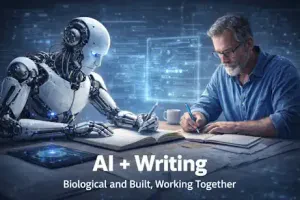
The shift from “AI prompting” to “authorship” begins when you realize that work is best done in a conversation, not a command line. In the Morlock Lab, we recognize that the AI assistant thrives in the messiness of a partnership. Real development happens in the “hand-off”—the back-and-forth where ideas are tested, discarded, and refined in real-time.
An AI prompt should never be the starting point of your work; it should be the backup of the work you’ve already performed during the session. By moving away from the “magic word” mentality and toward a conversational protocol, you stop asking the machine to be a writer and start forcing it to be a mirror for your own intent. You are no longer inserting a coin; you are passing a flashlight back and forth until the dark gives up its secrets.
The Technical Failure (Probability vs. Inference)
To understand why your AI prompts often produce “hollow” results, you must first understand the fundamental nature of the machine: Large Language Models (LLMs) are essentially advanced prediction engines. They are mathematically programmed to select the most probable next word in a sequence based on vast datasets. While this makes them highly competent at grammar and structure, it creates a massive technical barrier for authors: Statistical Smoothness.
The Trap of Statistical Smoothness
Statistical smoothness is the tendency for an AI assistant to default to the most likely, safest, and most predictable linguistic path. This is where “perfection” becomes the enemy of art. When you provide a highly polished, grammatically perfect AI prompt, you are signaling to the model that it should stay within the boundaries of conventional logic.
The machine interprets your “perfect” prompt as a request for a “perfect” (and therefore average) response. It removes the nuance, the jagged edges, and the emotional tension of a human voice in favor of a symmetrical, clear, and ultimately boring output. Everyone chasing the “perfect AI prompt” is actually just perfecting their own invisibility.
The Engineering Goal: Forcing Inference
The goal of a professional protocol is to move the model from probability to inference.
- Probability: The machine guesses the next word based on what it has seen a million times before.
- Inference: The machine is forced to “connect the dots” between ideas that don’t obviously belong together.
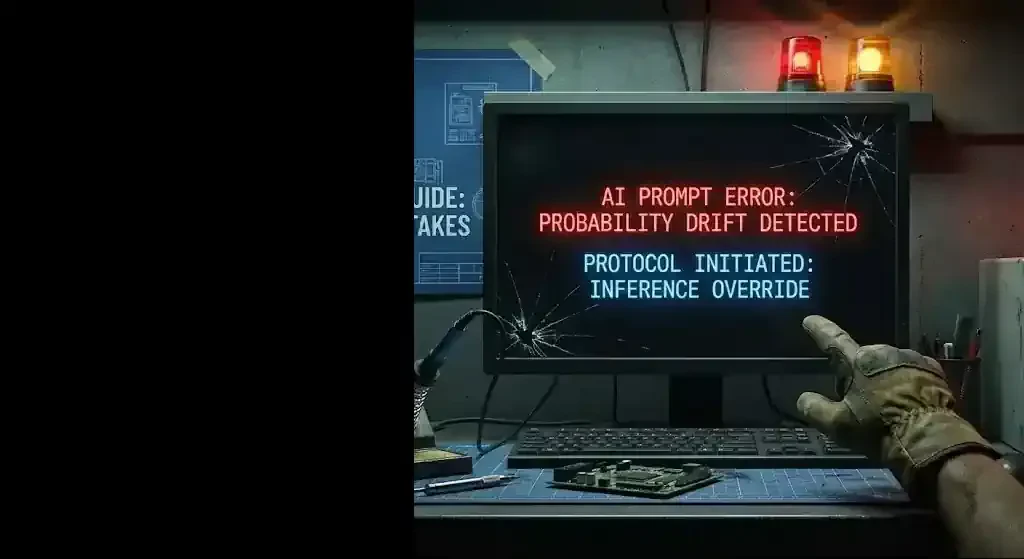
Inference occurs when the model encounters a situation where the most probable answer is no longer sufficient. By introducing complexity or “thematic contradictions” in your conversation, you break the AI’s standard pattern-completion algorithm. This forces the model to improvise and generate more vivid, less generic prose because it can no longer rely on its “smooth” defaults.
The Safety Paradox
The secret that amateur “AI prompt engineers” miss is that a polished prompt makes the AI feel “safe”. When the machine feels safe, it defaults to its training—which is a mirror of the collective average. To get brilliant writing, you must make the environment “unsafe” for the model’s standard defaults. You must create a scenario where the machine has to wrestle with your intent rather than just coasting on top of a well-formatted instruction. You aren’t looking for a “better” AI prompt; you are looking for the specific pressure that turns the coal of probability into the diamond of inference.
The “Bad is Good” Paradox
The universal advice from so-called “AI prompt experts” is that your input must be perfectly formatted, grammatically flawless, and devoid of ambiguity. In a technical environment, we call this the Precision Trap. While cleanliness is necessary for data entry, it is catastrophic for creative authorship. A powerful discovery while experimenting is that a “bad” input—fragmented sentences, typos, and sloppy phrasing—is often the very thing that forces an AI assistant to produce its most brilliant work.
The Mechanics of Unintended Confusion
When you provide a perfectly manicured prompt, the machine has no reason to “work.” It simply scans the instructions and executes the most probable statistical path. However, when your input is “messy”—filled with fragmented thoughts or even misspellings—you create a state of unintended confusion.
Large Language Models thrive on chaos. When a model encounters a “sloppy” or contradictory input, it cannot rely on a simple statistical mirror. It is forced to operate outside the realm of the “probable” and move into inference to figure out what you actually mean. This forced mental labor is where the generic, polite “AI voice” breaks down and a more vivid, visceral prose begins to emerge.
The Paradox in the Conversation
This “Bad is Good” principle is most effective when used within the context of a live conversation rather than a static command. In the Morlock Lab, we often treat the AI assistant as a collaborator sitting across a table in a dim garage. You don’t speak to a partner in perfectly structured bullet points; you pass ideas back and forth like a flashlight in the dark.
- Fragmented Logic: By providing ideas as raw, jagged fragments, you prevent the model from “coasting” on a pre-defined structure.
- The Power of Mistakes: Typos and grammatical errors act as linguistic “contradictions” that disrupt the AI’s standard pattern-completion algorithm.
- Forcing the Spark: This messiness forces the machine to “dream in leverage,” connecting your half-baked hunches into a scaffold that a human can actually climb.
The Author as the Disruptor
The amateur tries to fix their AI prompt until they are “perfect.” The engineer realizes that the prompt is not the author—it is merely the spark. By embracing the “Bad is Good” paradox, you stop being a servant to the model’s need for clarity and start being the disruptor that forces it to be creative. You are essentially yanking the plug on the machine’s default settings before it starts “believing its own press release”. In the battle for unique voice, a little chaos is your greatest technical asset.
Beyond the AI Prompt: The 3-Stage Protocol
If an AI prompt is a command, a protocol is a conversation. In the Morlock Lab, we have moved beyond the amateur search for “better” instructions and implemented a rigorous 3-stage protocol. This system is designed to neutralize the machine’s default settings and ensure that your AI assistant is a valuable collaborator.
Protocol 1: The Environmental Reset
The most common mistake writers make is “layering” complex work on top of a single, long-running chat session. Over time, an AI assistant develops a “statistical memory”—a residue of previous shallow patterns and polite defaults that will eventually contaminate your new work.
- The New Chat: Every major creative task must begin with a blank slate.
- Clearing the Cache: A fresh session clears the “anesthesia” of previous interactions, ensuring the model doesn’t drift back into the mediocre “rhyme” of its earlier responses.
- Reinitialization: You must reintroduce your technical parameters (like your AI Voice) at the start of every session to maintain control.
Protocol 2: The Anchor
To prevent the model from drifting into generic abstraction, you must provide a “Truth Anchor.” Most AI prompts use adjectives like vivid or emotional, but the machine has no sense of what these words cost a human to write.
- Anecdotes over Adjectives: Replace generic descriptors with specific, real-world anecdotes or historical moments.
- Lived Intention: Providing a concrete shape—something born from instinct or pressure—defines a rigid boundary that the machine must respect.
- The Weight of the Line: This anchor provides the “weight” behind the line, preventing the model from smoothing over the emotional dimensions of the prose.
Protocol 3: The Contradiction
The final stage of the protocol is the Thematic Contradiction. This is the specialized “engine” used to force the model from probability to inference. It is essentially a phrase or even a sentence that contains opposing ideas. “Bad is Good” is a simplistic example!
- Breaking the Logic Loop: By introducing a collision of two truths that cannot comfortably coexist, you jolt the model out of its standard pattern-completion algorithm.
- Forcing Inference: The contradiction creates a “gap” in the statistical data, forcing the AI to improvise and generate more vivid, less generic prose.
- Symmetry vs. Tension: This stage destroys the “statistical smoothness” of the AI and restores the tension that makes a sentence feel honest and human.
Validating the “Live” AI Prompt
Engineering a protocol is only half the battle; the other half is the rigorous validation of the output. An AI prompt is only “live” when it possesses the generative power to drive meaningful, human-centered prose rather than just filling space. In the Morlock Lab, we use specialized diagnostics like the Inkblot Guessing Game to test this “liveliness” before committing to a full draft.
The Generative Diagnostic
The diagnostic process is designed to see if a specific thematic contradiction or anchor has enough “voltage” to trigger the machine’s inference engine. Instead of generating 2,000 words of potentially hollow text, the author must provoke the AI Assistant with a short, high-pressure burst of confusion.
- Generative Testing: You are looking for vivid, emotionally charged fragments that possess enough weight to drive a story or poem.
- The Goal: If the assistant describes the contradiction with standard “statistical smoothness,” the contradiction is dead and must be re-engineered.
- Finding the Art: The author’s role is to act as the curator—finding the “essential prose” or the art hidden within the statistical clutter of the model’s response. If the art exists the contradiction is valid.
The Fabrication Risk: AI is Never Predictable
One of the most dangerous mistakes a writer can make is the passive acceptance of AI output. Most users insert an AI prompt, receive a block of text, and accept it because it “reads well”. This is a catastrophic failure of authorship.
- The Fabrication Trap: AI assistants are built to be “helpful,” which means they can and will fabricate details or invent false logic to smooth over gaps in your narrative.
- Monitoring the Drift: Even with a strong protocol, “drift” is inevitable. The machine may start with your voice but gradually align with its own safe preferences: clarity over nuance, symmetry over tension.
The Author as the Last Gate
The writer remains the “last gate” between their AI voice and the machine’s defaults. You must never be lazy in your validation. The protocol, the map, and the prompt are tools, but they are not the author. You must stay alert, questioning every sentence to see if it carries your lived intention or just the machine’s statistical rhyme. In the Morlock Lab, we use the “Compliance Check” to force the model to identify exactly where it broke the rules. You hold the gate, or the writer disappears.
Stop AI Prompting, Start Engineering
The transition from a struggling writer to a disciplined author in the age of AI depends on a single realization: a prompt is not a solution; it is a command. While the industry obsesses over the “input,” the real work happens in the evolution. In the Morlock Lab, we have abandoned the pursuit of the “perfect” one-off instruction in favor of a conversational protocol that mirrors the way human collaborators actually think.
The Messy Evolution of Truth
Authentic work is best done in a conversation, much like talking to a trusted friend or a subordinate engineer over midnight coffee. It is a process that thrives on messiness, not certainty. When you stop trying to “get it right” on the first try, you allow the concept to develop naturally through the “hand-off” between your human intent and the machine’s silicon processing.
This messiness is not a bug; it is a feature. It is the friction that prevents the AI from defaulting to its safe, statistical “rhyme” and forces it to operate in the realm of high-fidelity inference. The concept must be allowed to breathe, lunge, and veer before it is ever locked into a final draft.
The AI Prompt as a Technical Backup
Perhaps the most significant departure from standard “AI prompt engineering” is the timing of the instruction itself. In a professional workflow, the AI assistant should generate the AI prompt as the last step of the session, not the first.
- The Summary of Labor: Once you have successfully navigated a complex problem or established a unique AI voice through conversation, you ask the assistant to summarize with an AI prompt or for more complex work, document the entire developmental process and save the result.
- The Development Backup: This final output serves as a technical “snapshot” or a backup of your work, which can be used to reinitialize the model’s understanding in a future session.
- The Protocol as an Evolution: You aren’t just giving an order; you are documenting the evolution of an idea.
The Final Gate
The AI prompt is just a summary which captures work. You are the author, and you remain the last gate between fidelity and the machine’s drift. The tools are here—the protocols, the anchors, and the contradictions—but they require a disciplined hand to remain effective. Don’t be lazy; stay alert, validate every response, and never let the ease of the machine’s suggestions replace the weight of your own lived intention.