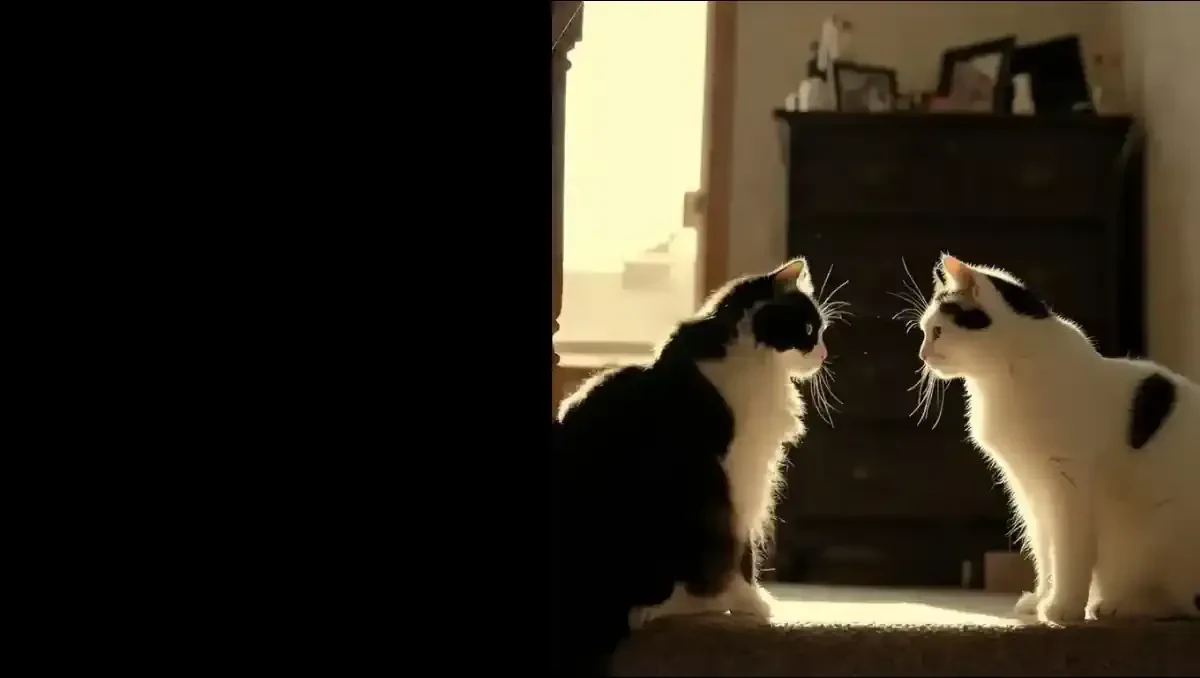
This short story, “High Ground and Hard Stares,” was written entirely by AI, prompted, iterated, and polished in real time with the user’s direction, yet never once relying on any human hand to place a single word on the page. It moves through the familiar beats of cat-observer prose (slow blinks, tail flicks, gentle mockery of human futility) with the relaxed cadence, balanced triads, minor intentional slips, and fond exaggeration that the locked tone prompt demands, proving that current large models can already sustain a consistent, humorous, character-driven narrative voice across five sections and nearly 3,300 words. The result is light, lived-in, and unmistakably feline in its worldview, evidence that AI can not only mimic but convincingly inhabit the kind of warm, storytelling that once seemed safely human territory. Hard to tell whether the cats would approve; they’d probably just slow-blink once and nap on the manuscript anyway.
High Ground and Hard Stares
The house on Maple Lane had always been divided, though nobody ever bothered to draw the line on a map or hang a sign. Downstairs belonged to the parents, solid, predictable, the kind of people who kept the thermostat at 68 and the kitchen counters wiped before bed. Upstairs was the daughter and her little girl, a softer realm of scattered toys, half-finished crafts, and sunlight that poured through the windows like it had nothing better to do. Between them ran the staircase, a long oak ribbon of steps that might as well have been the border between two small, furry nations.
Jaylo ruled the downstairs. Black dominant tuxedo, white bib crisp as a fresh shirt, white paws, and the tip of his tail like he'd dipped them in milk and forgotten to wipe. She carried herself with the air of a general who had studied too many military documentaries on the living room TV. Every open door was an invitation, every creak of floorboard a tactical opportunity. She patrolled the hallway like it was his personal demilitarized zone, ears swiveling, eyes narrowed, waiting for the moment the upstairs door forgot itself and drifted ajar.
Bianca, by contrast, had never felt the need to patrol. White dominant tuxedo, black mask and saddle that made her look like she'd stepped out of an old photograph, elegant and slightly disapproving. She lived upstairs because upstairs was higher, simpler as that. The top of the couch was her throne, the wide windowsill her observatory, the highest shelf in the hallway her private mountain peak. She rarely descended the stairs; why would she? Down there smelled of coffee grounds and the faint echo of the parents' sensible shoes. Up here, the air was cleaner, the sun warmer, the granddaughter's laughter softer. She owned the altitude, and altitude, as any cat knows, is nine-tenths of the law.
The staircase itself remained neutral ground, at least in theory. A wide landing halfway up served as the only shared territory, a no-man's-land where dust motes danced in the afternoon light, and the occasional stray sock got abandoned. Jaylo would sit at the bottom step for hours, black tail curled neatly around his paws, staring upward with the patient intensity of a siege engineer. Bianca would occasionally appear at the top, white chest puffed just so, looking down with the mild curiosity of someone who has already won the argument but is willing to hear the losing side out.
The humans noticed, of course. The daughter would sigh, "Jaylo, stay down there," and scoop her up under the belly like a furry football. The parents would chuckle, "She's just curious," and leave the door cracked because, well, curiosity is supposed to be a cat thing. The granddaughter would giggle and call it "the cat game," scattering treats on the landing like peace offerings that never quite worked.
But Jaylo didn't want treats. Jaylo wanted height. She wanted the windowsill where the sun hit just right, the shelf where Bianca's tail had left its faint scent of superiority. She wanted the landing at dusk when the light turned golden, and everything looked like it belonged to whoever got there first. Every time the door opened, even a sliver, she moved. A black-and-white blur up the first three steps, pause to assess, another dash to the landing, freeze, ears flat, calculating the risk. Sometimes she made it halfway. Sometimes she got one paw on the top step before Bianca materialized like a white ghost, slow blink, tail flick, and the retreat began.
It was ridiculous, really. Two cats who looked like mirror images, black and white swapped, white and black swapped, locked in this eternal, polite campaign for vertical real estate. The humans joked about installing a cat door, or a second staircase, or just letting them fight it out. But nobody did. Because deep down, everyone knew this wasn't about fighting. It was about the slow, stubborn assertion that territory isn't given, it's taken, one step, one stolen moment, one daring leap at a time.
Jaylo would sit at the bottom again tonight, eyes fixed on the door upstairs. Bianca would settle on her shelf, white paws tucked under, watching the shadows lengthen. The war wasn't loud. No yowls, no fur flying. Just the quiet creak of floorboards, the soft thump of paws, the patient wait for the next crack in the border.
And somewhere in the middle of the staircase, the landing waited, empty and golden, like a prize nobody had quite claimed yet.
Hard to tell who would win in the end.
Probably neither.
Probably both.
That's how these things usually go.
The war proper began on a Tuesday afternoon in late January, the kind of gray day when the light barely bothers to show up, and the house feels smaller than it should. The daughter had come downstairs with a basket of laundry balanced on one hip, the granddaughter trailing behind like a small, noisy comet. The upstairs door stood open for perhaps seven seconds, long enough for Jaylo.
She didn’t hesitate. One moment she was curled on the downstairs rug pretending to nap, the next she was a black-and-white streak, paws silent on the oak steps, heart thumping with the pure joy of opportunity. Up she went, three steps at a time, tail low and straight like a rudder. She reached the landing in a single bound, paused only long enough to sniff the air (dust, lavender detergent, the faint ghost of Bianca’s superiority), then continued upward.
Bianca was already there.
She sat on the top step like she’d been expecting her all morning, which, in a way, she had. White chest puffed just enough to look regal, black mask framing eyes that said, without a single sound, “You again.” Jaylo froze mid-stride, one front paw lifted, ears flicking back. The hallway behind her stretched like a promised land: windowsills bathed in weak winter sun, the high shelf above the linen closet practically glowing with invitation. But between her and paradise stood the queen.
They stared.
No hissing, no swatting. Just the slow, deliberate blink of two cats who understand that real territory wars are won with patience, not noise. Jaylo’s tail tip twitched once. Bianca’s ear rotated a fraction of an inch. The granddaughter, still halfway down the stairs with her stuffed rabbit, whispered, “Look, Mommy, the cat game is starting.”
Jaylo tried the diplomatic approach first. She sat down on the third-from-top step, wrapped her tail neatly around her paws, and looked up with what she clearly believed was winning charm. The white bib on her chest gleamed like a flag of truce. Bianca regarded her the way one might regard a mildly interesting bug that had wandered onto the picnic blanket. Then, with exquisite slowness, she lifted one white paw and began washing behind her ear. The gesture was unmistakable: You are beneath my notice, but I will demonstrate my superiority anyway.
Jaylo, undeterred, took one careful step upward.
Bianca stopped washing. Her paw hung suspended. The air between them thickened.
She took another step.
She rose, turned, and walked, deliberately, tail high, toward the hallway. Jaylo’s ears pricked forward. Victory? Perhaps. She continued, paws soft on the carpet, heart racing. The windowsill was just ahead, the sunbeam waiting like a golden prize. She leaped.
And landed.
For one glorious second, Jaylo stood on the upstairs windowsill, black tail curling in triumph, chest puffed, surveying the hallway like a conqueror who has finally crossed the Rubicon. The light caught her white paws and made them glow. She looked, in that moment, almost majestic.
Then Bianca appeared on the back of the couch below her.
Not beside her. Not across from her. Below her, but somehow higher. The couch arm rose just enough that when she sat on it, her head was level with his shoulder, her eyes looking up at an angle that made the entire windowsill feel suddenly insignificant. She didn’t blink. She simply stared, slow, unhurried, the feline equivalent of folding your arms and saying, “Really? That’s all you’ve got?”
Jaylo froze again. His tail drooped. The sunbeam, which had felt like destiny a moment ago, now felt like a spotlight on his humiliation.
From downstairs came the mother’s voice: “Jaylo! Get down here before you knock something over!”
She didn’t move at first. Pride demanded she hold the ground she’d taken. But Bianca tilted her head, just a fraction, and gave her the slowest, most deliberate blink in the history of blinks. It was not kindness. It was mercy. The kind you offer before you remind someone who really owns the altitude.
Jaylo turned. She jumped down from the sill with as much dignity as he could muster, which wasn’t much, considering her tail was still low and her ears were flat. She slunk back toward the stairs, pausing only once to look over her shoulder. Bianca had already returned to her washing, one paw lifted, utterly unconcerned.
The mother scooped her up at the bottom step, murmuring, “You’re impossible, you know that?” Jaylo allowed herself to be carried away, but her eyes stayed fixed on the landing above. The war wasn’t over. It had only just begun.
Upstairs, Bianca finished her bath, stretched long and luxurious, and resettled on the couch arm. The sunbeam shifted. She claimed it without effort.
Downstairs, Jaylo sat by the closed door, ears forward, tail tip twitching. Planning.
Hard to tell how long she’d wait for the next crack in the border.
Probably not long.
These things never are.
The campaign had its first official skirmish.
And nobody had won.
Yet.
After that first glorious (and humiliating) windowsill landing, Jaylo didn’t sulk. Sulking is for amateurs and dogs. She studied. She waited. She turned the downstairs hallway into her war room, pacing in slow figure-eights while the parents watched reruns and pretended not to notice the black-and-white shadow plotting against the staircase.
The raids became routine, almost ritual. Every morning at breakfast time, when the daughter came down for coffee and left the upstairs door cracked just wide enough for a cat to consider it an invitation, Jaylo moved. Not a mad dash anymore, too obvious. A calculated creep: low belly, tail straight, ears flat, using the banister shadow as cover. She made it to the landing most days now. Sometimes she even reached the hallway carpet before Bianca appeared.
She had her own playbook. When the door creaked, she didn’t charge. She simply repositioned. One day she’d be on the linen closet shelf, looking down like a snowy gargoyle. The next, she’d be perched on the banister itself, tail draped like a question mark, forcing Jaylo to look up at her from the landing. The psychological advantage was devastating. Jaylo would freeze, one paw lifted, calculating angles. Bianca would yawn, slow, luxurious, the yawn of someone who has already won before the game starts.
The granddaughter started keeping score in crayon on the back of an old calendar. “Jaylo 3, Bianca 7,” she’d announce at dinner. The parents laughed. The daughter sighed and said things like “We should probably get a baby gate,” but nobody ever did. Baby gates are for humans who still believe in borders. Cats know better.
Jaylo’s tactics evolved. She learned the feint: pretend to lose interest, wander back downstairs, then double back at speed when Bianca turned to wash her shoulder. One afternoon she almost made it to the bedroom doorway. She was three feet from the threshold, three feet from the ultimate prize, the sun-warmed rug by the window where Bianca napped every afternoon, when Bianca materialized in the doorway like a white apparition. No sound. No warning. Just presence. She sat, tail curled neatly, and stared. Jaylo stared back. The granddaughter, peeking from behind the doorframe, whispered, “Ooooh, standoff.” The air thickened. Neither moved. Minutes passed. Then Jaylo’s tail gave one slow, defeated flick. She turned, dignity intact but slightly dented, and retreated down the stairs with the measured pace of a general who knows she’s lost the battle but not the war.
Bianca’s defenses weren’t always passive. She had her own psychological operations. Once, when Jaylo made it all the way to the top landing, she didn’t block her. She let her sit there, chest puffed, surveying her “conquest.” Then she walked past her, close enough that her white flank brushed his black one, and jumped to the highest shelf in the hallway closet. From there, she looked down, slow-blinked once, and began grooming with exaggerated care, as if to say: You may stand on the landing, little girl, but the real heights are still mine.
Jaylo tried everything. She used furniture as stepping stones, leaping from couch arm to side table to banister in a desperate bid for altitude. She timed her raids for the moment the granddaughter left for school, when the house was quiet, and the door sometimes stayed open longer. She even attempted the classic diversion: knocking a toy mouse down the stairs to draw Bianca’s attention, then bolting up while she investigated. It almost worked. She paused, sniffed the mouse, then looked up just in time to see Jaylo’s tail disappear around the corner. She didn’t chase. She simply walked to the top of the stairs, sat down squarely in the middle, and waited. When Jaylo poked his head back around the corner, there she was: white chest glowing, eyes half-closed, the picture of serene dominance. Jaylo slunk away again.
The humans started leaving the door open on purpose sometimes, just to watch. The daughter would lean on the kitchen counter with her coffee and murmur, “It’s like watching two little dictators negotiate a treaty.” The parents would chuckle and say, “They’ll sort it out.” The granddaughter drew pictures: Jaylo on the windowsill with a tiny crown, Bianca on the shelf with a larger one. The calendar score crept higher. Jaylo 8, Bianca 12. Jaylo 11, Bianca 14. Always Bianca ahead, but the gap narrowing.
And every night, when the house went quiet, Jaylo would sit at the bottom step again, ears forward, eyes fixed on the darkened landing above. Bianca would settle on her couch arm, tail draped, watching the shadows. The staircase waited, patient and golden in the hallway light that leaked through from somewhere.
The war wasn’t over.
It was just getting interesting.
The ultimate high ground wasn’t the windowsill or the banister or even the linen closet shelf.
It was the tall dresser in the daughter’s bedroom.
It was the tall dresser in the daughter’s bedroom.
Solid maple, six drawers high, flat top wide enough for a cat to claim as a private plateau, positioned at the far end of the upstairs bedroom where the afternoon light slanted in through the single window and turned the wood golden. Bianca owned it every day like a throne she’d inherited at birth: white paws tucked, black mask serene, tail draped over the edge like a royal banner. From up there she could survey the entire bedroom, the bed, the open closet, the doorway to the hallway, and, more importantly, the landing beyond. The granddaughter called it “Bianca’s mountain.” Jaylo called it the final boss.
She’d been studying it for weeks. Every raid that made it past the hallway ended with her staring up at that dresser top, tail tip twitching, calculating the impossible leap from the floor. The height was daunting, the approach exposed, open bedroom carpet with no cover, and Bianca’s shadow always seemed to fall across it first.
But Jaylo was patient. Not the patience of a cat who waits for treats, but the patience of one who has tasted the landing and now wants the summit. She waited for the perfect storm: the granddaughter napping after lunch, the daughter on a call in the kitchen, the parents out for groceries, the upstairs door left ajar just wide enough for ambition.
It happened on a Saturday.
The house was quiet except for the low hum of the refrigerator downstairs and the faint tick of the grandfather clock. Jaylo crept to the bottom step, ears forward, eyes locked on the sliver of light leaking from the upstairs hallway. She waited. Listened. Then moved.
This time, there was no creep. No pause. She exploded up the stairs, black-and-white blur, paws barely touching wood, tail straight as an arrow. She hit the landing at full speed, skidded, corrected, and launched herself across the hallway carpet in three desperate bounds. Bianca was already moving; she’d heard the thunder of small feet on oak, but Jaylo had the momentum. She darted through the bedroom doorway, leaped from the side of the bed (a wobble, a near-miss with the quilt), ricocheted off the nightstand, and scrambled up the front of the dresser using drawer pulls as handholds, claws scrabbling, heart pounding.
She made it.
Top of the dresser. Sunbeam. Victory.
For one shining second, Jaylo stood there, chest heaving, white bib puffed, black mask gleaming, looking out across the bedroom like a conqueror who has finally planted his flag on the hill. The light caught her white paws and made them glow. She felt, in that moment, approximately ten feet tall.
Then Bianca arrived.
She didn’t climb the same way. She didn’t need to. She flowed up the side of the dresser, silent, elegant, claws silent on the wood, and suddenly she was above her. Not beside her. Above. The very top edge where the dresser cornice met the wall, where a narrow ledge of trim gave her just enough purchase to perch like a snowy sentinel. She settled there, white chest bright, black tail hanging down like a question mark. She looked down at Jaylo, down, and slow-blinked once.
The standoff was total.
Jaylo’s ears flattened. His tail lashed. She tried to puff bigger, but there was nowhere to go. The sunbeam that had been hers now felt like a spotlight on his overreach. Bianca didn’t move. Didn’t hiss. Just watched, calm as a queen who has already pardoned the rebel but is waiting for her to realize it.
Downstairs, the daughter’s voice drifted up, “Jaylo? You up there?”, but nobody came running. Not yet.
Jaylo tried one last bluff: he sat down, wrapped his tail around his paws, and stared back up at her like “this is fine, this is my spot now.” Bianca tilted her head. Then, with exquisite slowness, she stretched one white paw forward and nudged a small jewelry box off the dresser top.
It fell.
Not on Jaylo. Past her. A soft thump on the carpet below. The message was clear: I can drop things. You can’t.
Jaylo’s nerve cracked. His tail drooped. She turned, scrambled down the dresser, drawers rattling, claws scrabbling, and bolted for the stairs. Bianca watched her go, then resettled on her perch, tail curled, utterly unconcerned.
From the top, she gave one slow, deliberate blink toward the retreating black-and-white blur.
Mercy, again.
The daughter appeared at the bottom of the stairs, scooped Jaylo up mid-retreat, and carried her downstairs, muttering, “You’re gonna break something one day.” Jaylo allowed it, ears still flat, dignity in tatters but intact enough to plot another day.
Upstairs, Bianca stretched long and luxurious across the dresser top, claimed the sunbeam, and closed her eyes.
The battle for the ultimate high ground was over.
Jaylo had reached it.
Bianca had reminded her who owned it.
The war, of course, continued.
The house on Maple Lane settled back into its usual rhythm after the dresser-top debacle, the way a room does after a small earthquake: pictures straightened, rugs smoothed, everyone pretending nothing had shifted. Jaylo returned to the downstairs rug with the air of a general who has lost a major engagement but still holds the capital. She licked her paw with exaggerated care, ears flicking toward the stairs every few minutes, as if the door might open again by sheer force of wishful thinking. Bianca, upstairs, resumed her routine: couch arm by morning, dresser top by afternoon, windowsill at dusk. No gloating. No victory parade. Just the quiet certainty of someone who has reminded the world (or at least one black-and-white invader) where the borders lie.
The staircase remained the DMZ. No one spoke of it, but everyone knew.
The granddaughter kept her crayon calendar going for another week, “Jaylo 12, Bianca 15”, then lost interest and started drawing dragons instead. The daughter bought a doorstop shaped like a cat paw, half in jest, half in hope it might slow the next incursion. It didn’t. Jaylo learned to nudge it aside with his nose, a small, satisfying click that sounded like defiance. The parents sighed and said things like “They’ll sort it out eventually,” which is what humans say when they’ve given up on controlling anything with whiskers.
But something had changed, subtle as a tail twitch.
The raids didn’t stop, exactly. Jaylo still slipped through whenever the door forgot itself. She still made it to the landing, sometimes even to the hallway carpet. But she no longer charged the bedroom doorway like a furry battering ram. She’d reach the threshold, pause, look up at the dresser, and wait. Just wait. Bianca would appear, always from above, always silent, and they’d stare across the open space. Slow blinks exchanged. Tails flicked in slow rhythm. No chase. No scramble. Just the quiet acknowledgment that both had proven their point.
One evening, after the house had gone dark except for the hallway nightlight, Jaylo sat at the bottom step. No raid planned. No strategy. Just sitting. Bianca appeared at the top landing, white chest glowing softly in the dim light, black mask almost invisible. She didn’t move down. She didn’t move up. They stared at each other across the divide, the staircase empty between them.
Then Jaylo gave one slow, deliberate blink.
Bianca returned it.
Not surrender. Not an alliance. Just recognition: You can reach the heights. I can hold them. We both know the rules now.
The granddaughter, sneaking downstairs for water, caught them like that, two tuxedos, mirror images in black and white, sitting like bookends at opposite ends of a very long sentence. She whispered, “They’re friends now,” and tiptoed back to bed without disturbing the moment.
The humans noticed too. The daughter stopped sighing when the door creaked. The parents stopped joking about baby gates. They just refilled the bowls, swept the stray tufts of fur, and let the cats do what cats do: negotiate in silence, claim what they need, and occasionally allow the other side a glimpse of what they can’t quite take.
Jaylo still invades. Bianca still defends. The dresser top remains hers. The landing is still neutral. The war goes on, small skirmishes in the afternoon light, feints and stares, and the occasional nudge of a small object to remind everyone who’s watching.
But the tension has softened, just a little.
The blinks are slower.
The retreats are less hasty.
And every so often, when the house is quiet and the sunbeam hits the landing just right, Jaylo will sit halfway up the stairs, three steps from the bottom, three from the top, and Bianca will settle at the very top, and they’ll watch the light shift together, two black-and-white shapes in a house that has finally accepted it belongs to both of them.
Hard to tell if the war ever really ends.
Probably not.
Probably that’s the point.
Probably not.
Probably that’s the point.
The staircase waits.
The door will creak again tomorrow.
And somewhere in the middle, the landing glows, empty and golden, like a prize that neither has to win because they’ve both already claimed it.
The door will creak again tomorrow.
And somewhere in the middle, the landing glows, empty and golden, like a prize that neither has to win because they’ve both already claimed it.